
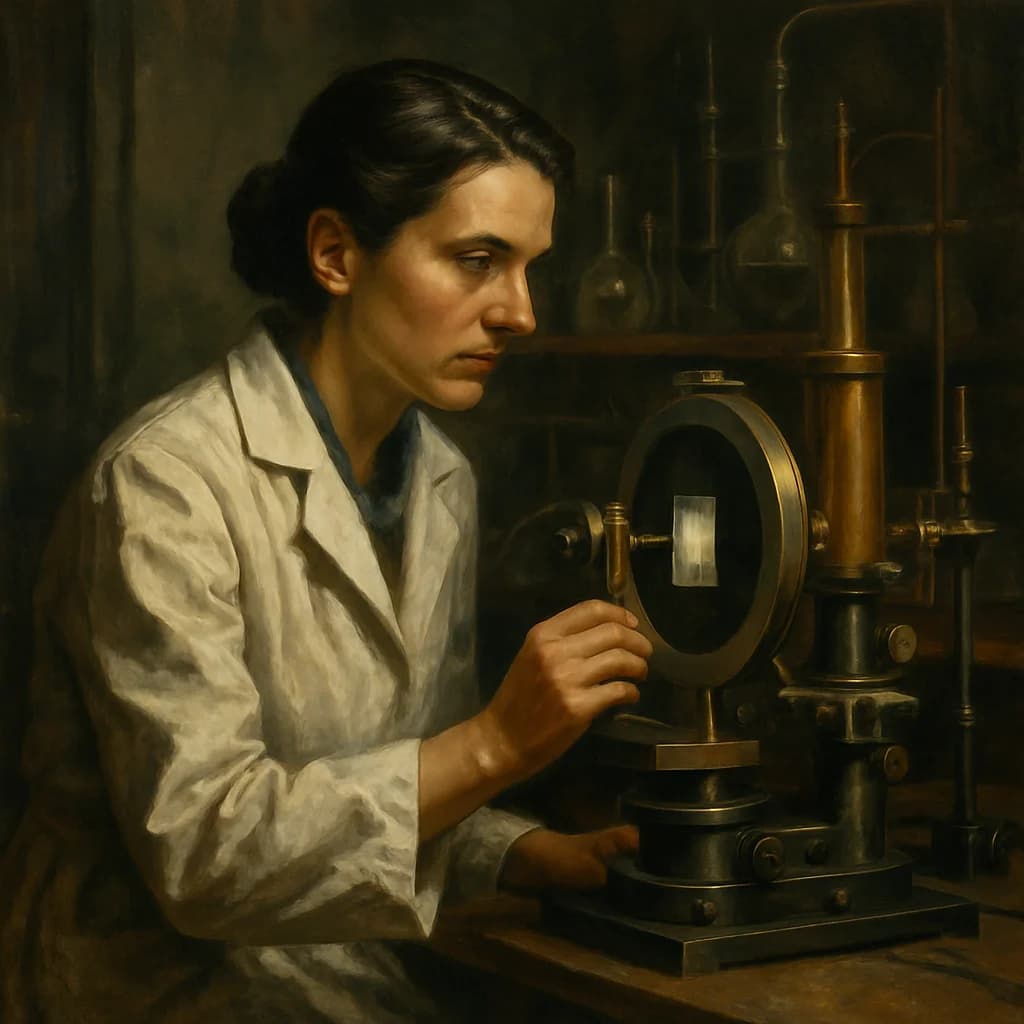
Rosalind Franklin
The woman who unlocked the secret of life never lived to see two men accept a Nobel Prize for her work.
Rosalind Franklin arrived at King's College London in 1951 with a reputation as one of Europe's most skilled X-ray crystallographers. She had spent three years in Paris perfecting techniques that could reveal the hidden architecture of molecules, and now she was ready to tackle the most elusive puzzle in biology: the structure of DNA. What she didn't know was that her new colleague, Maurice Wilkins, already considered DNA "his" project and viewed her arrival as an unwelcome intrusion.
Franklin's methodical approach clashed immediately with the boys' club atmosphere of King's College. While James Watson and Francis Crick theorized wildly at Cambridge, she generated the clearest X-ray images of DNA ever produced. Her photograph "Photo 51" revealed the helical structure with stunning precision, but Wilkins showed it to Watson without her knowledge or consent in January 1953. Within weeks, Watson and Crick had built their famous model, crediting Franklin's data as merely "confirming" their theory.
The theft of credit might have been forgotten if Franklin had lived to fight for recognition. But she had already moved to Birkbeck College, where she pivoted to studying virus structures with characteristic precision. She published groundbreaking work on the tobacco mosaic virus and was closing in on the structure of polio when ovarian cancer, possibly triggered by years of radiation exposure, began its swift advance. She died in 1958 at thirty-seven, four years before Watson, Crick, and Wilkins shared the Nobel Prize.
The Nobel Committee's rules prohibited posthumous awards, conveniently erasing Franklin from the story. Her notebooks, filled with meticulous observations that had solved the DNA puzzle months before the famous Cambridge duo, gathered dust while textbooks celebrated the triumph of two men who had built their fame on her stolen work.
Franklin's X-ray crystallography work was so advanced that she determined DNA's helical structure and the position of its phosphate groups eight months before Watson and Crick published their model.
Why untold: Nobel Prize rules against posthumous recognition allowed the scientific establishment to write Franklin out of the DNA discovery story after her early death.
The Laboratory Where Women Had No Names
In Marie Curie's shadow, a generation of brilliant women scientists worked without credit, their discoveries published under male colleagues' names, until one of them broke the silence.
Photo 51 Cracked DNA. She Never Got the Credit.
She discovered the structure of DNA, but a single photograph stolen from her lab gave two men a Nobel Prize.
- Maddox, Brenda. Rosalind Franklin: The Dark Lady of DNA. HarperCollins, 2002.
- Sayre, Anne. Rosalind Franklin and DNA. W. W. Norton, 1975.
- Watson, James D. The Double Helix: A Personal Account of the Discovery of the Structure of DNA. Atheneum, 1968.