
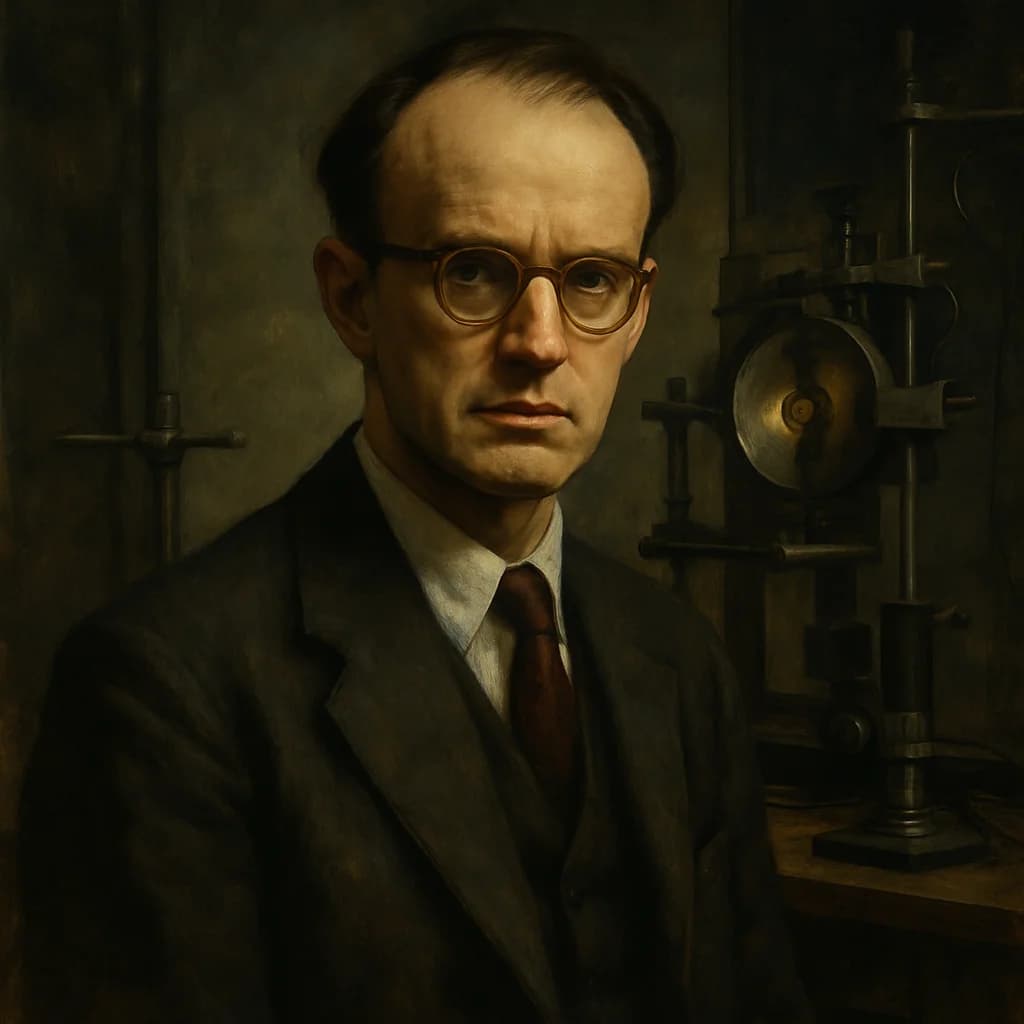
Maurice Wilkins
The man who helped unlock DNA's secrets spent his final decades convinced that science itself had become a weapon of mass destruction.
Maurice Wilkins never intended to become the third wheel in history's most contentious scientific discovery. A New Zealand-born physicist who'd worked on radar during WWII, he stumbled into biology almost by accident when King's College London offered him a job studying the physical properties of living matter. By 1950, he was using X-ray crystallography to peer into the structure of DNA: tedious, meticulous work that required shooting X-rays through crystallized genetic material for hours at a time.
When Rosalind Franklin joined his lab in 1951, Wilkins expected a research assistant. Instead, he got a brilliant, uncompromising scientist who considered DNA her exclusive domain. Their professional relationship soured immediately. Franklin worked alone, guarding her data jealously, while Wilkins found himself relegated to the sidelines of his own research project. The tension reached a breaking point when Wilkins showed Franklin's famous "Photo 51" (the clearest image of DNA's helical structure ever captured) to James Watson without her knowledge. Watson and Francis Crick used that stolen glimpse to crack the code first.
Wilkins shared the 1962 Nobel Prize with Watson and Crick, but the victory felt hollow. Franklin had died of cancer four years earlier, ineligible for the award and largely written out of the discovery's official history. The guilt ate at him. He spent his remaining decades as a fierce advocate for nuclear disarmament, convinced that scientific progress without ethical restraint would doom humanity. The man who helped reveal life's blueprint became obsessed with preventing science from destroying life itself.
Wilkins died in 2004, still wrestling with the moral weight of that moment when competitive ambition trumped scientific integrity, and changed biology forever.
Wilkins initially trained as a physicist and worked on the Manhattan Project's uranium separation process before switching to biology, making him one of the few Nobel laureates to contribute to both atomic weapons and genetic research.
Why untold: His complex role as both collaborator and competitor in the DNA discovery has been overshadowed by the Watson-Crick-Franklin narrative, obscuring his genuine scientific contributions and later ethical evolution.
The Laboratory Where Women Had No Names
In Marie Curie's shadow, a generation of brilliant women scientists worked without credit, their discoveries published under male colleagues' names, until one of them broke the silence.
Photo 51 Cracked DNA. She Never Got the Credit.
She discovered the structure of DNA, but a single photograph stolen from her lab gave two men a Nobel Prize.
- Wilkins, Maurice. 'The Third Man of the Double Helix: The Autobiography of Maurice Wilkins.' Oxford University Press, 2003.
- Maddox, Brenda. 'Rosalind Franklin: The Dark Lady of DNA.' HarperCollins, 2002.
- Watson, James D. 'The Double Helix: A Personal Account of the Discovery of the Structure of DNA.' Atheneum, 1968.