
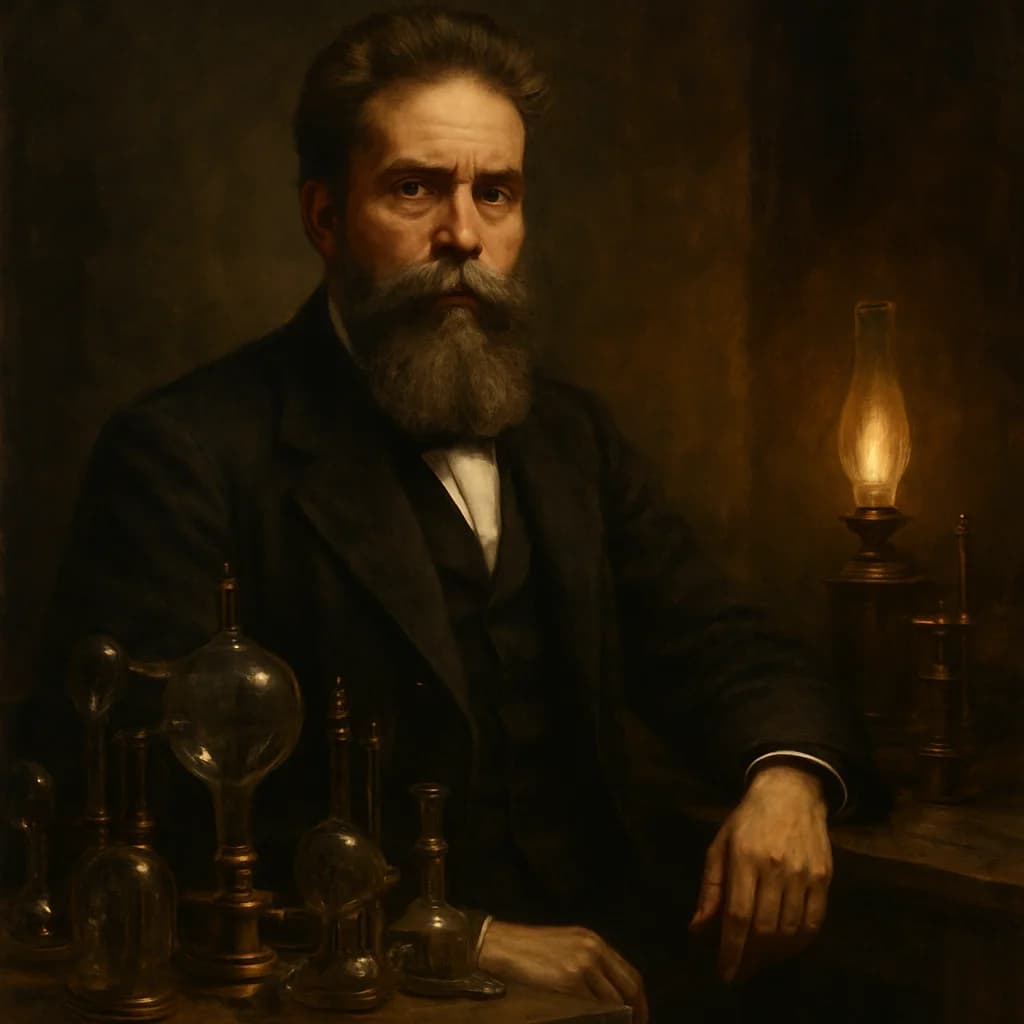
Wilhelm Röntgen
He refused to patent his discovery, refused the money, and refused to let anyone name it after him, then died broke.
Wilhelm Röntgen discovered X-rays on the evening of November 8, 1895, almost by accident, while fiddling with a cathode ray tube in his darkened laboratory in Würzburg. Within six weeks, doctors were using his discovery to peer inside living human bodies. Within two years, armies were deploying X-ray units in field hospitals. He had, essentially, handed medicine a superpower, and then quietly stepped back from all of it.
What gets lost in the story of X-rays is the specific texture of Röntgen's character, which was stubborn to the point of self-destruction. When the Nobel Committee awarded him the first-ever Nobel Prize in Physics in 1901, he attended the ceremony but refused to deliver the traditional lecture explaining his work. He accepted the prize money (50,000 Swedish kronor) and donated the entire sum to the University of Würzburg. He wouldn't patent the discovery because he believed scientific knowledge belonged to everyone. He wouldn't even let the rays be called Röntgen rays, a name that physicists in many countries used anyway out of sheer respect. He called them X-rays because he didn't know what they were, and he thought honesty about ignorance mattered more than a legacy.
The First World War ruined him financially. Röntgen had invested his personal savings in German government bonds and annuities, and when Germany's postwar hyperinflation arrived, those savings dissolved into worthlessness within a few years. He spent his final years in Munich in genuine poverty, quietly working in his lab, largely forgotten by a scientific community already racing past him. His wife Bertha, who had been the subject of the first-ever X-ray image of a human hand (her ring visible on her finger, her bones stark and white against the dark), had died in 1919. He followed her in 1923, dead of colorectal cancer at 77.
There is a particular irony in the fact that a man who spent decades working with ionizing radiation died of cancer. The medical consensus is that his laboratory shielding was far better than most of his contemporaries', so the cancer was probably not his discovery's fault. Probably.
The first X-ray image ever taken was of Bertha Röntgen's left hand, including her wedding ring, produced on December 22, 1895. She reportedly looked at the image and said it reminded her of her own death.
Why untold: Röntgen's deliberate rejection of patents, prizes, and personal branding erased him from the commercial and cultural narrative his own discovery generated, leaving a ghost in the machine of modern medicine.
A Paris Lab Accident Produced History's Most Dangerous Discovery
In 1895, a laboratory accident in Paris created the most dangerous discovery in human history, and the scientist had no idea what he'd done.
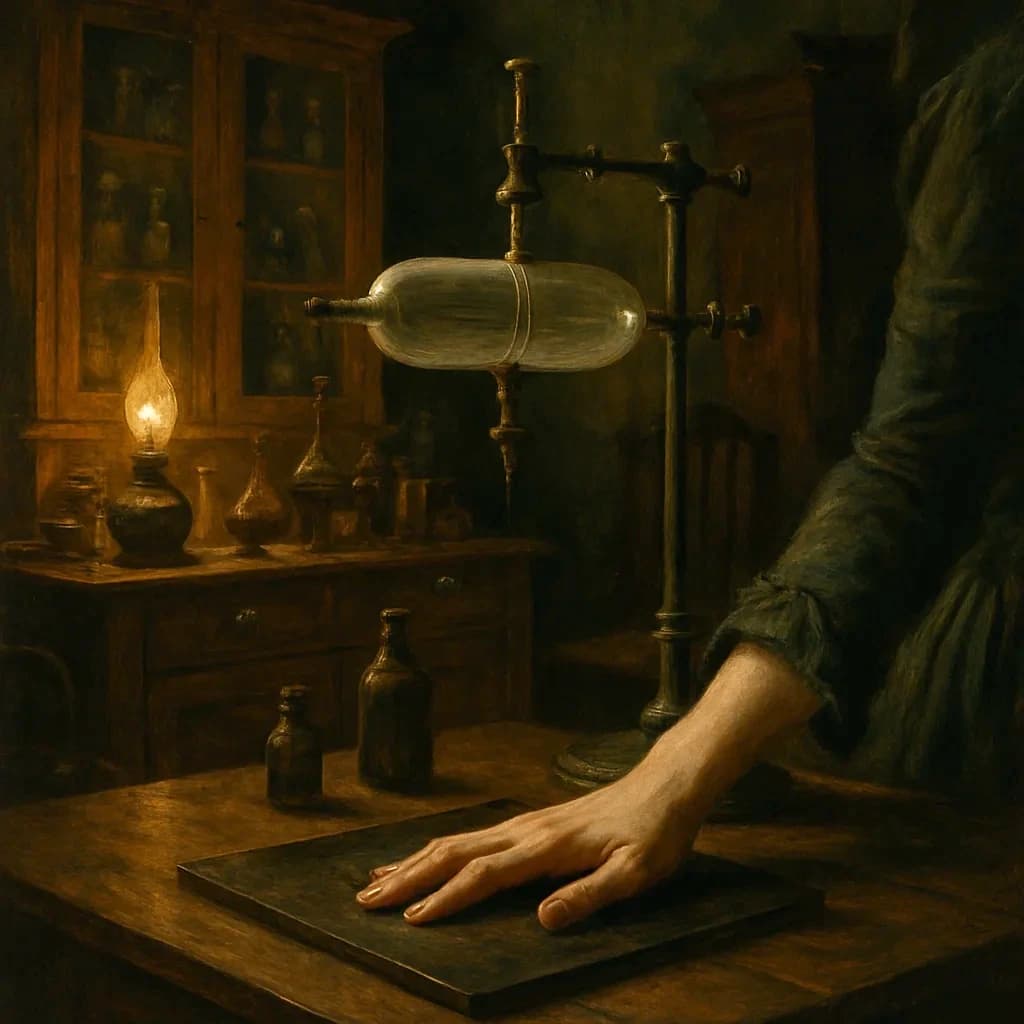
She Saw the Bones of Her Own Living Hand
A German housewife's kitchen experiment in 1886 created something that would outlive empires and reshape human consciousness itself.
- Nitske, W. Robert. The Life of Wilhelm Conrad Röntgen, Discoverer of the X Ray. University of Arizona Press, 1971.
- Glasser, Otto. Wilhelm Conrad Röntgen and the Early History of the Roentgen Rays. Norman Publishing, 1993.
- Nobel Prize Committee. 'Wilhelm Conrad Röntgen: Biographical.' NobelPrize.org, Nobel Media AB, 1901.