
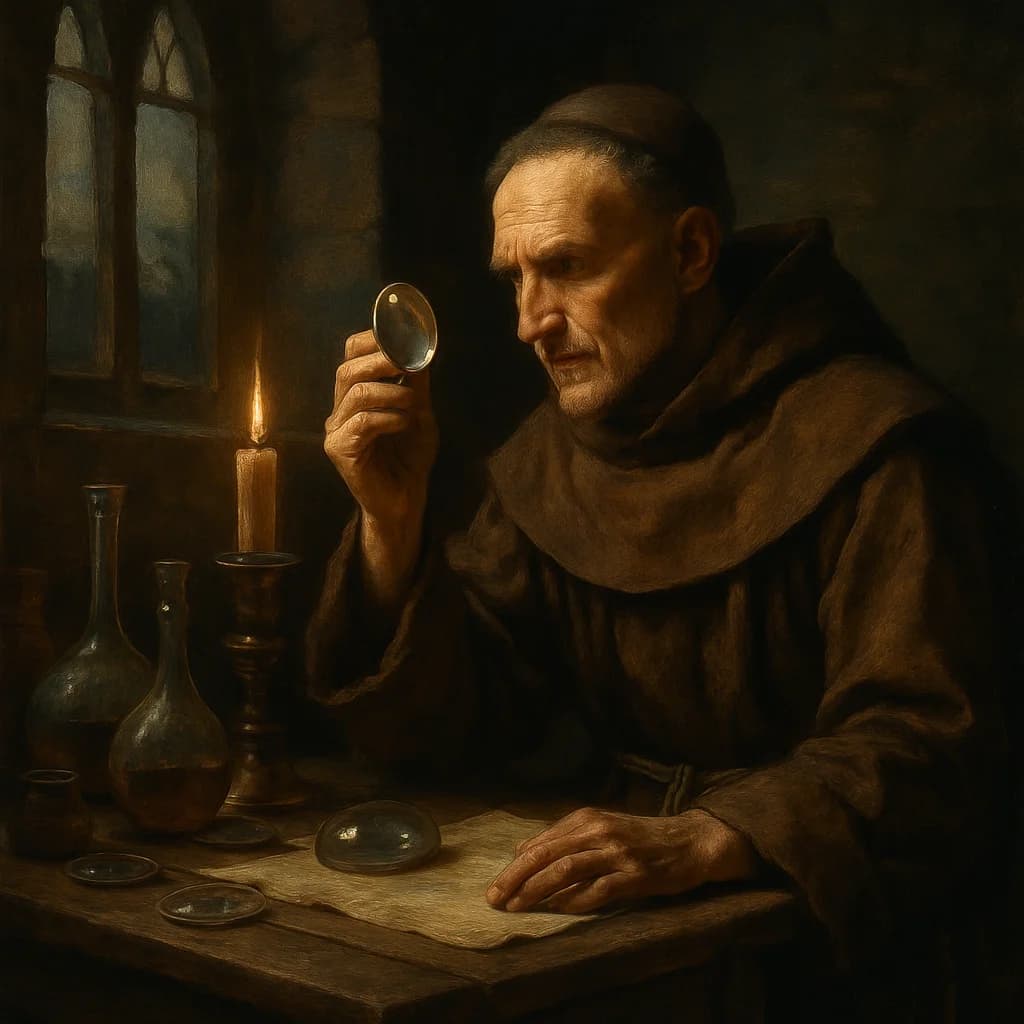
Roger Bacon
The medieval friar who built a camera obscura, predicted flying machines, and described eyeglasses 500 years before anyone thought to invent them was locked away by his own church for practicing forbidden magic.
Roger Bacon spent thirteen years in solitary confinement not for heresy, but for being too right about the future. While his fellow Franciscans copied manuscripts by candlelight, Bacon was grinding lenses, mixing chemicals, and writing detailed instructions for machines that wouldn't exist for centuries. His crime wasn't questioning God. It was bypassing Aristotle.
In his cell at the Franciscan house in Paris around 1278, Bacon penned descriptions of telescopes, microscopes, and automobiles with the casual precision of a man describing his breakfast. He wrote about gunpowder's military applications decades before Europeans had seen a cannon, detailing how "a small quantity of this matter, no bigger than a thumb, makes such a horrible sound that it seems like thunder, and the flash appears more brilliant than lightning." He wasn't guessing. Bacon had somehow acquired the closely guarded Chinese formula through his network of correspondents stretching from Oxford to Constantinople.
What terrified the Church wasn't his experiments. It was his method. Bacon insisted that true knowledge came from direct observation, not ancient texts. He built instruments, recorded measurements, and demanded mathematical proof. "Reasoning draws a conclusion," he wrote, "but does not make the conclusion certain unless the mind discovers it by the path of experience." This was intellectual treason in an age when contradicting Aristotle could cost you everything.
The man who coined the term "experimental science" died in obscurity around 1294, his revolutionary manuscripts gathering dust in monastery libraries. His mechanical designs, optical theories, and chemical formulas would be "rediscovered" centuries later by men who became famous for ideas Bacon had already perfected while Europe still believed the earth was flat.
Bacon described the exact process for making eyeglasses in 1267, including the precise curvature needed for different vision problems, but his work remained buried in monastic libraries until glasses were independently "invented" in Italy around 1300.
Why untold: Medieval chroniclers dismissed his work as sorcery, and later historians focused on his philosophical writings while overlooking his practical inventions and scientific method.

A Monk Designed a Flying Machine in 1260
Six hundred years before the Wright brothers, a thirteenth-century monk's obsession with falling led to humanity's first scientific attempt at powered flight.

He Accidentally Invented One of History's Deadliest Weapons
A Chinese inventor's discovery accidentally created one of history's deadliest weapons, and he didn't even know what fire was for.

How a Botched Immortality Potion Toppled Castle Walls
A Chinese alchemist's failed bid for immortality handed European soldiers the power to bring down any castle wall.

The Merchant Who Funded Inventions a Century Too Early
A Genoese trader's ledger from 1347 contained items that shouldn't have existed for another century.
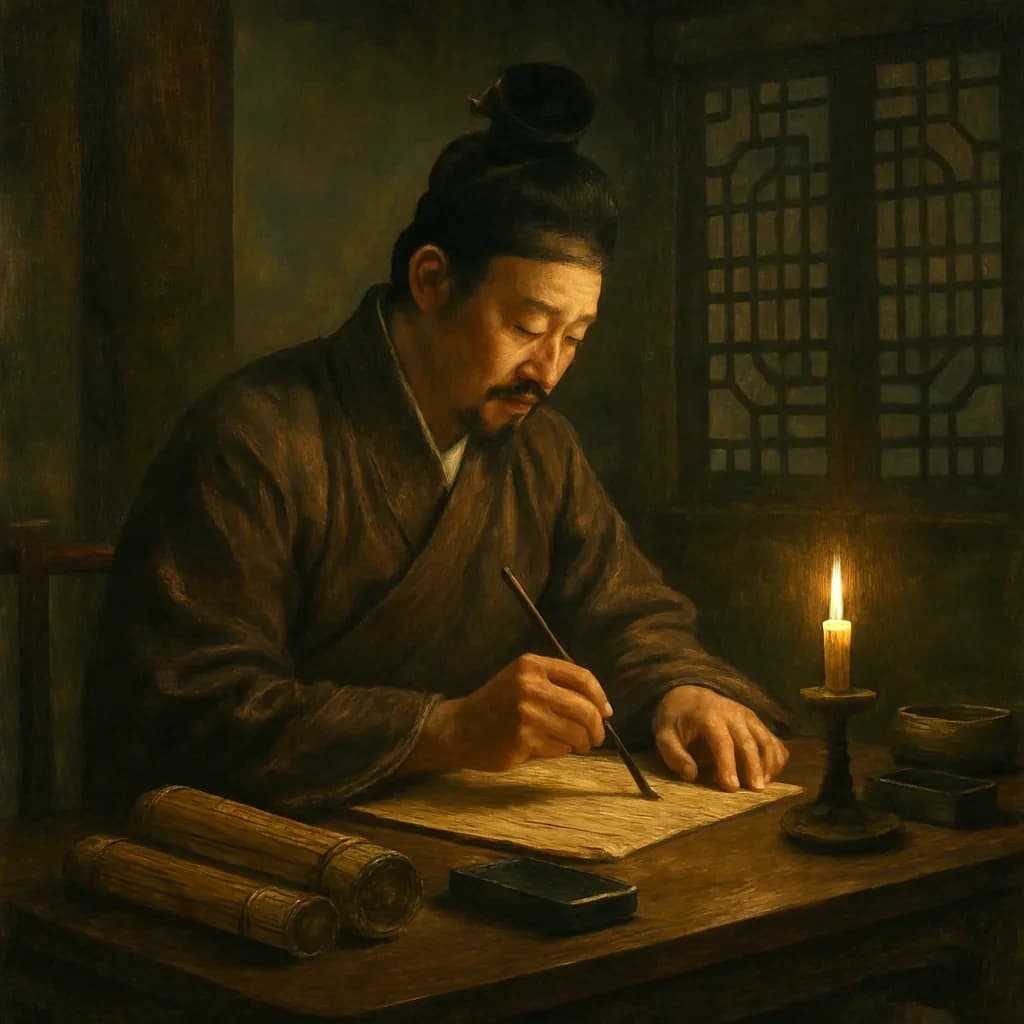
A Korean Scholar's Cookbook Became a Chemical Warfare Blueprint
A Korean scholar's cookbook became the blueprint for chemical warfare across three continents.
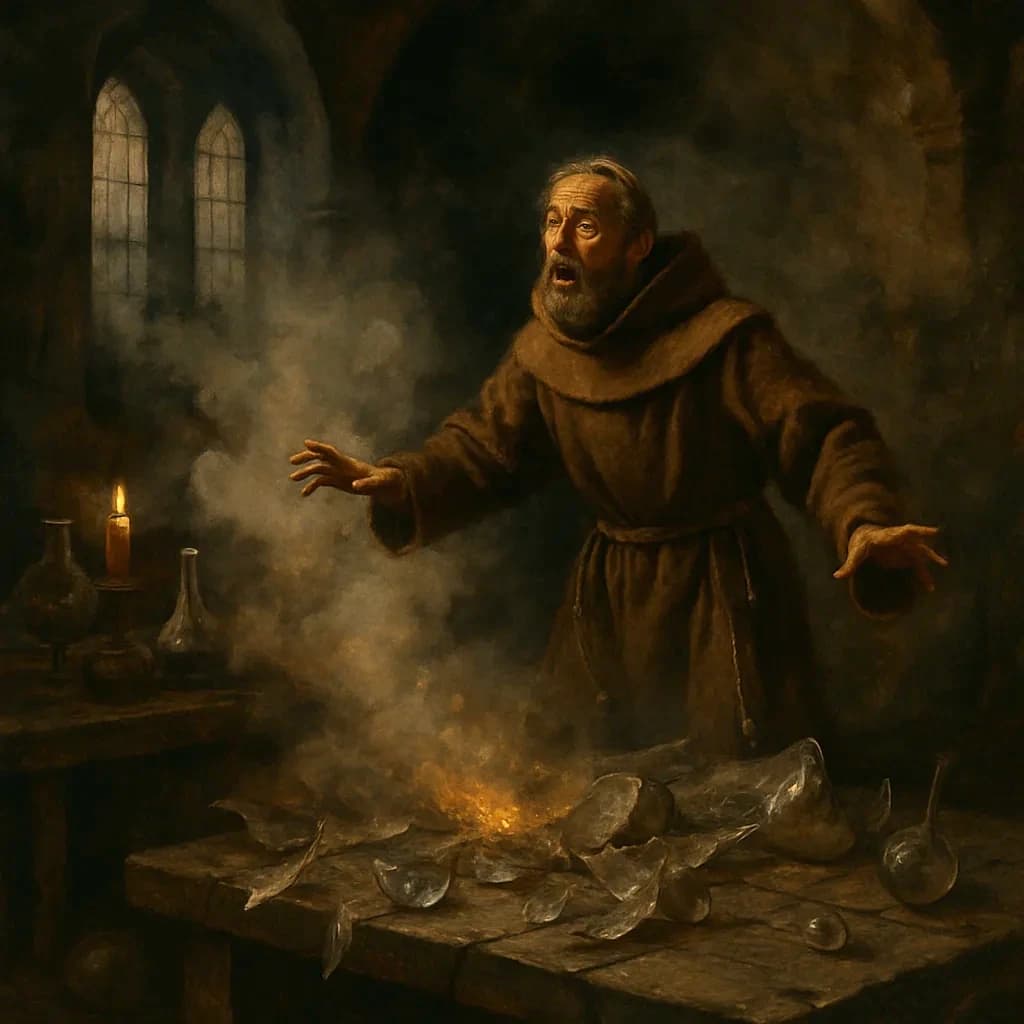
Devil's Soap: How a Friar's Cleaning Recipe Became Gunpowder
A chef's family formula for making soap created modern chemistry, and accidentally gave birth to the deadliest weapons in human history.
- Lindberg, David C. Roger Bacon and the Origins of Perspectiva in the Medieval West. Oxford University Press, 1996.
- Hackett, Jeremiah. Roger Bacon and the Sciences: Commemorative Essays. Brill Academic Publishers, 1997.
- Clegg, Brian. The First Scientist: A Life of Roger Bacon. Carroll & Graf Publishers, 2003.