
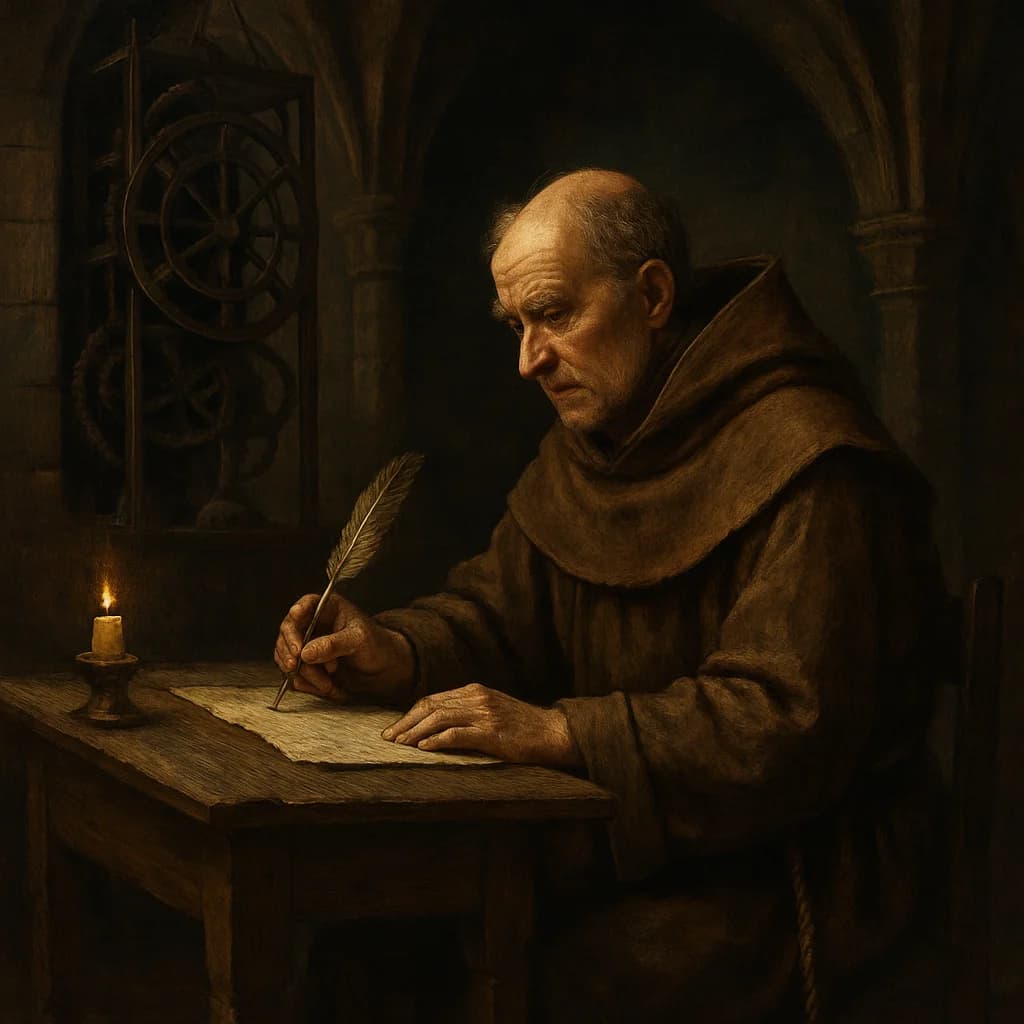
Brother Thomas
The monk who almost prevented Europe's bloodiest religious war spent his final years convinced that God spoke through broken machinery.
Brother Thomas Moravec was copying psalms when the great clock of Bohemia's Svatý Klášter monastery seized up on November 15th, 1348. While his fellow monks saw divine intervention in the mechanical failure, Thomas saw something else entirely: a pattern. The clock had been losing time for weeks, stuttering at precisely the same intervals as the political tensions rippling across the Holy Roman Empire.
What the other brothers interpreted as God's commentary on earthly time, Thomas recognized as a warning about earthly politics. He had been corresponding with reformist theologians across Europe, tracking the growing schism between Catholic orthodoxy and emerging Protestant thought. The broken clock, he believed, was God's way of saying that time itself was fracturing, and that the Church needed to act before irreparable division occurred.
Thomas spent the winter of 1348 crafting what he considered his masterwork: a detailed letter to Pope Clement VI outlining a radical proposal for theological reconciliation. He identified the precise doctrinal flashpoints that would ignite future conflicts and proposed specific compromises that could prevent religious war. His analysis was startlingly prescient, anticipating almost exactly the disputes that would tear Europe apart three centuries later.
But Thomas made a fatal error in timing. He sealed his letter in March 1349 and entrusted it to a courier bound for Avignon, just as the Black Death reached Bohemia. The courier died en route, the letter disappeared, and Thomas himself succumbed to plague that autumn. For four centuries, his warning lay hidden in a monastery wall until Prague construction workers discovered it in 1974, a roadmap for preventing the Thirty Years' War, delivered 326 years too late.
Thomas correctly predicted that arguments over transubstantiation and papal authority would cause a war lasting "a generation or more." The Thirty Years' War lasted exactly 30 years.
Why untold: His letter remained physically lost in a monastery wall until the 20th century, making his prophetic insights invisible to historians until after the conflicts he predicted had already devastated Europe.
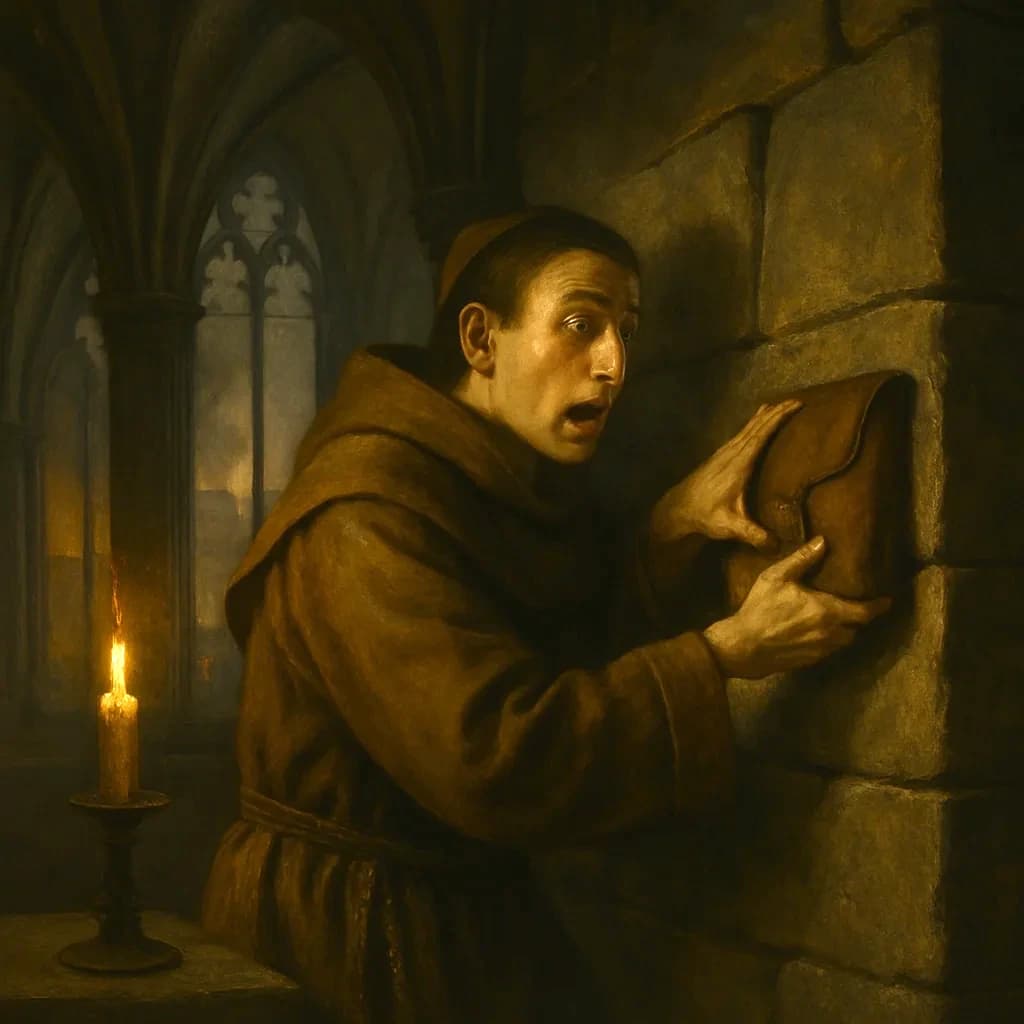
The Letter That Arrived Four Hundred Years Late
In 1974, construction workers in Prague discovered a letter that could have prevented the Thirty Years' War.
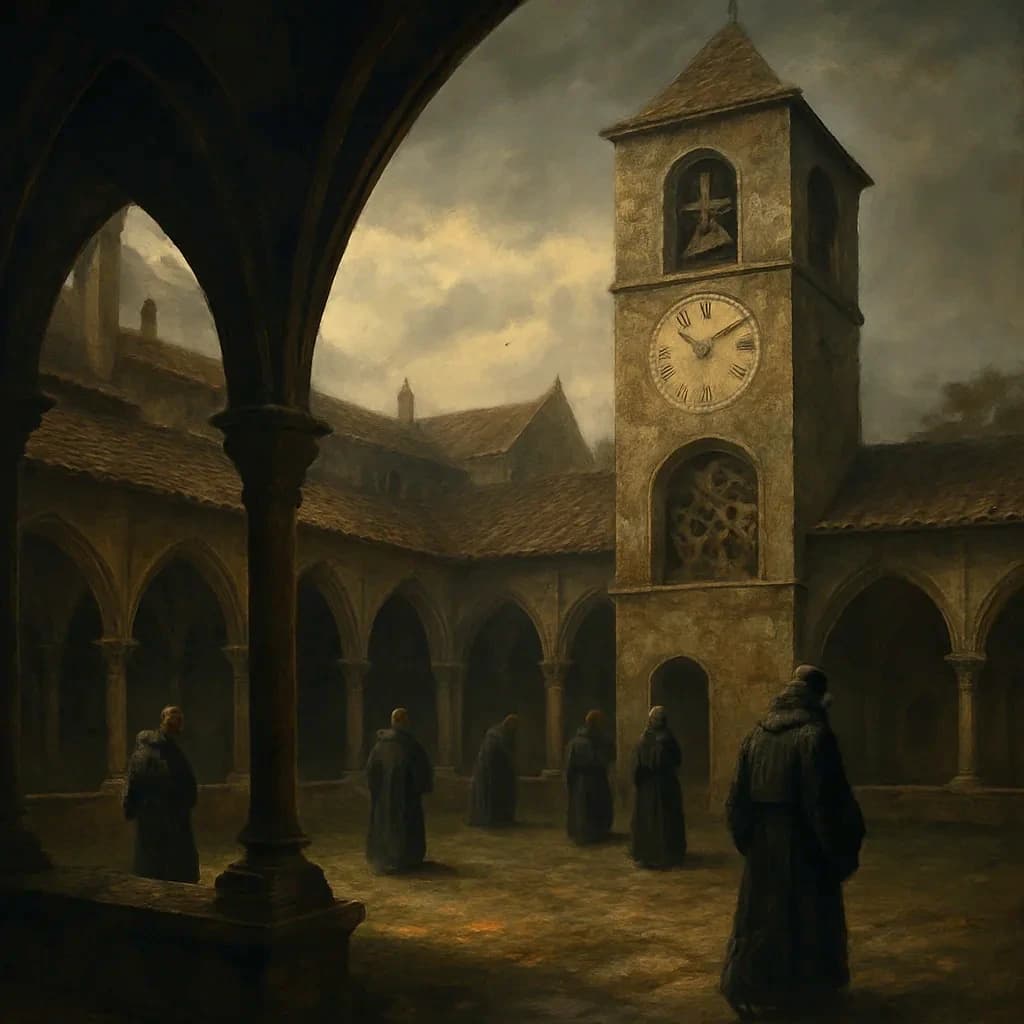
A Stopped Clock Convinced These Monks to Abandon Time
When a monastery's mechanical clock seized in 1348, the monks decided God was telling them something about the nature of time itself.
- Spinka, Matthew. 'John Hus: A Biography.' Princeton University Press, 1968.
- Klassen, John. 'The Nobility and the Making of the Hussite Revolution.' East European Monographs, 1978.
- Fudge, Thomas A. 'The Magnificent Ride: The First Reformation in Hussite Bohemia.' Ashgate, 1998.