
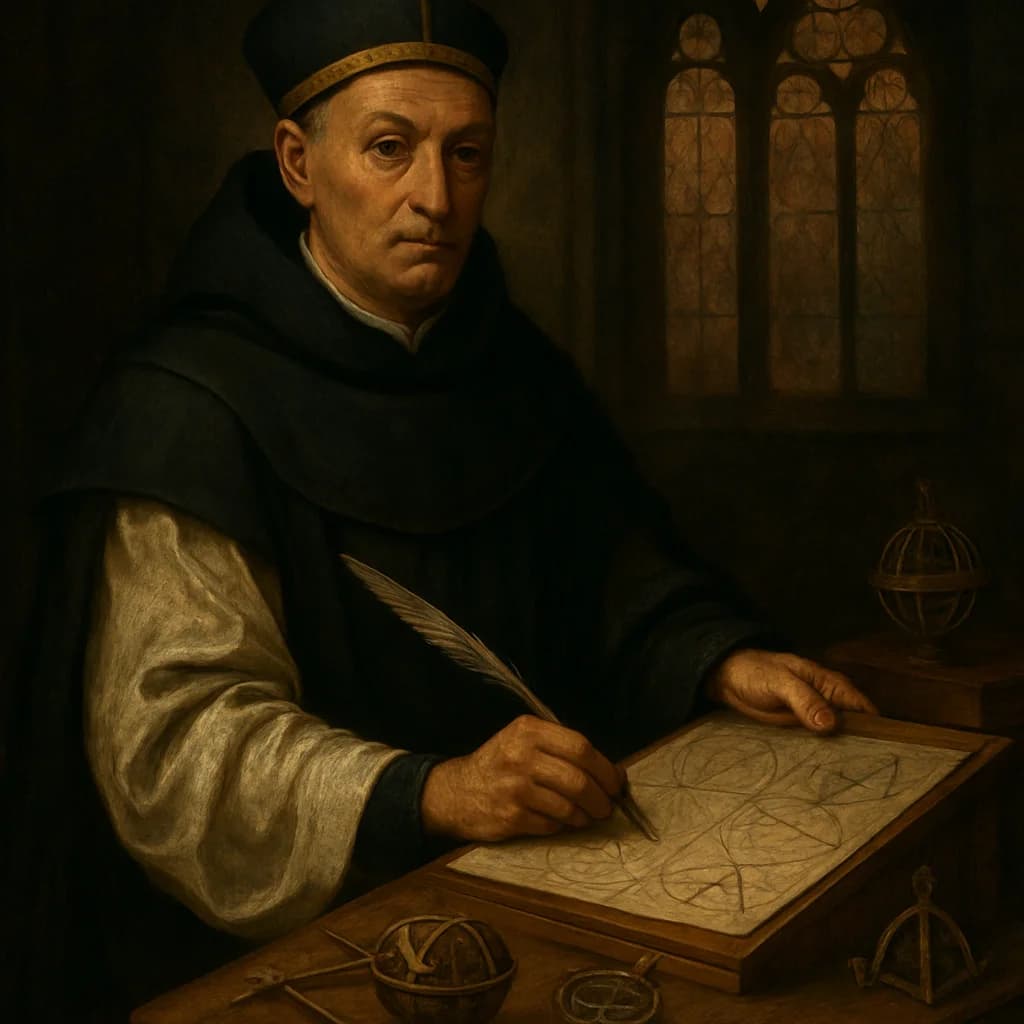
Nicole Oresme
The man who invented economic theory, overthrew Aristotle, and nearly proved the Earth rotates centuries before Copernicus was a medieval bishop who thought mathematics was the language of God.
Nicole Oresme walked into the University of Paris in 1348 carrying questions that would shatter medieval thought. While the Black Death ravaged Europe and monks debated whether broken clocks meant God was ending time itself, this Norman peasant's son was quietly revolutionizing how humans understood motion, money, and the cosmos.
Oresme didn't just study infinity. He weaponized it. His mathematical proofs demonstrated that infinite series could converge to finite sums, a concept so radical that fellow theologians whispered about heresy. But mathematics was only his warm-up act. He translated Aristotle's works into French, then systematically demolished them. Where Aristotle claimed heavy objects fall faster, Oresme developed theories of acceleration that wouldn't be formalized until Galileo. Where ancient Greeks insisted the Earth stood still, Oresme constructed geometric proofs showing rotation was not only possible but elegant, arguments so compelling that even he hesitated to embrace them fully.
But perhaps his most prescient insights concerned money. Watching kings debase currency to fund wars, Oresme wrote the first systematic analysis of monetary policy, arguing that manipulating coin values created inflation and economic instability. His 'Treatise on the Origin, Nature, Law, and Alterations of Money' reads like a medieval preview of modern economics, complete with supply-and-demand curves expressed in scholastic Latin.
By 1377, this mathematical revolutionary had become Bishop of Lisieux, preaching sermons while his notebooks overflowed with logarithmic functions and planetary calculations. He died in 1382, leaving behind works that wouldn't be fully understood for centuries. The Catholic Church, recognizing dangerous thinking when they saw it, quietly shelved his more radical mathematical proofs about infinity and divine omnipotence.
Oresme invented coordinate geometry two centuries before Descartes, using it to graph the relationship between velocity and time in ways that directly anticipated calculus.
Why untold: Medieval mathematical achievements were systematically overshadowed by Renaissance humanism's focus on classical Greek and Roman sources rather than 'dark age' innovations.
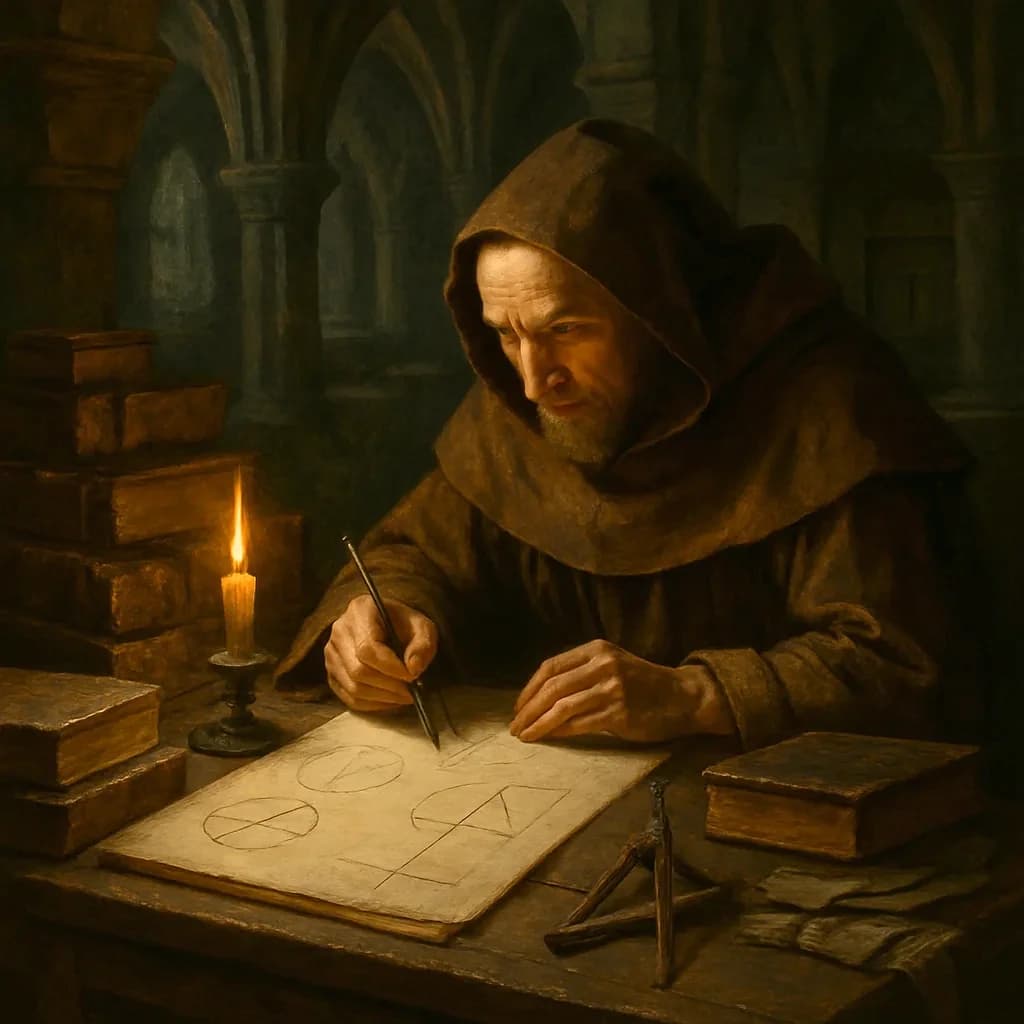
He Proved Some Infinities Are Bigger, Then Disowned It
A medieval mathematician's proof that infinity comes in different sizes nearly got him burned as a heretic.
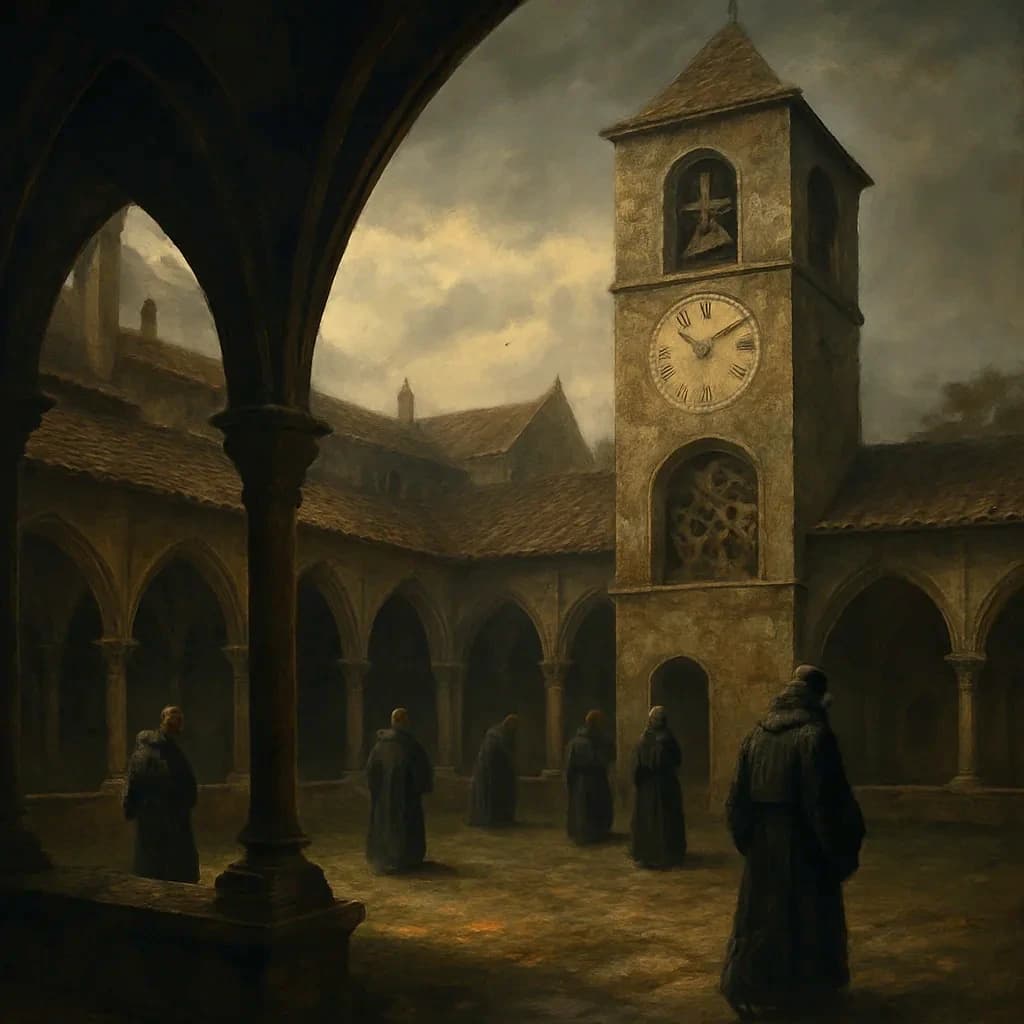
A Stopped Clock Convinced These Monks to Abandon Time
When a monastery's mechanical clock seized in 1348, the monks decided God was telling them something about the nature of time itself.
- Grant, Edward. 'Nicole Oresme and the Kinematics of Circular Motion.' University of Wisconsin Press, 1971.
- Koyré, Alexandre. 'From the Closed World to the Infinite Universe.' Johns Hopkins University Press, 1957.
- Clagett, Marshall. 'The Science of Mechanics in the Middle Ages.' University of Wisconsin Press, 1959.