
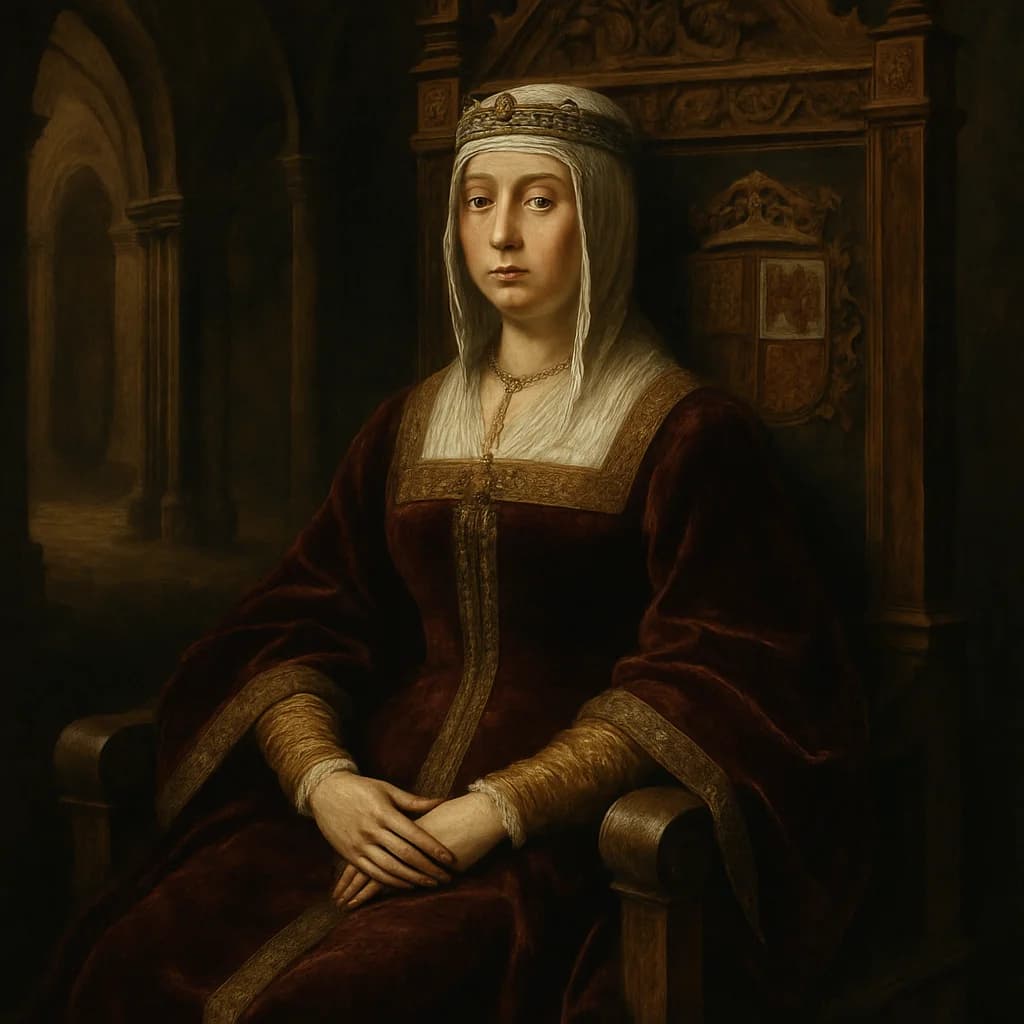
Queen Isabella I of Castile
The queen who united a fractured kingdom by marrying her enemy's nephew, then accidentally funded the discovery of a continent while trying to break a Venetian spice monopoly.
Isabella of Castile spent her childhood watching her kingdom tear itself apart. When her half-brother Henry IV died in 1474, leaving the throne disputed between Isabella and his supposed daughter Juana, Castile faced another brutal succession war. Isabella's solution was audacious: she had already secretly married Ferdinand of Aragon in 1469, uniting their rival kingdoms through what amounted to a hostile takeover disguised as romance.
But Isabella's real genius lay in understanding money. While other European monarchs bled their treasuries on endless wars, she revolutionized royal finance. She established the Santa Hermandad, a quasi-military police force that collected taxes while maintaining order, essentially turning law enforcement into a profit center. When Granada fell in 1492, completing the Reconquista, Isabella found herself with a unified kingdom and, more importantly, a functioning treasury.
That same year, a Genoese navigator named Columbus appeared at court with charts showing a westward route to the Indies. Isabella's decision to fund his voyage wasn't romantic wanderlust. It was cold economic calculation. Venice controlled the eastern spice routes, charging outrageous markups. If Columbus could reach the Indies directly, Castile would break the Venetian stranglehold on European trade.
The irony was perfect. Columbus never reached the Indies, but he handed Isabella something far more valuable: a New World that would pour silver into Spanish coffers for centuries. Her investment in breaking a trade monopoly accidentally created the largest empire in human history. She died in 1504, just as the first shipments of American gold began arriving in Seville, transforming her unified but modest kingdom into the dominant global superpower.
Isabella pawned her personal jewelry to fund Columbus's voyage, but the total cost, about 1.4 million maravedís, was less than what the royal court spent on a single feast.
Why untold: Her shrewd financial innovations are overshadowed by the dramatic narratives of the Reconquista and Columbus's voyages.
One Misplaced Digit Sent Europe Across the Oceans
A Florentine bookkeeper scratched down a number in 1345 that would determine who controlled half the known world for the next three centuries.

When Aristotle's Ghost Haunted Columbus
A 2,000-year-old mathematical error convinced Columbus that China was just around the corner from Spain.

Genoa's Bankers Quietly Owned the New World
A bank clerk's routine ledger review revealed that someone had quietly stolen half the known world.
- Liss, Peggy K. 'Isabel the Queen: Life and Times' (2004)
- Rubin, Nancy. 'Isabella of Castile: The First Renaissance Queen' (1991)
- Phillips, William D. 'The Worlds of Christopher Columbus' (1992)