
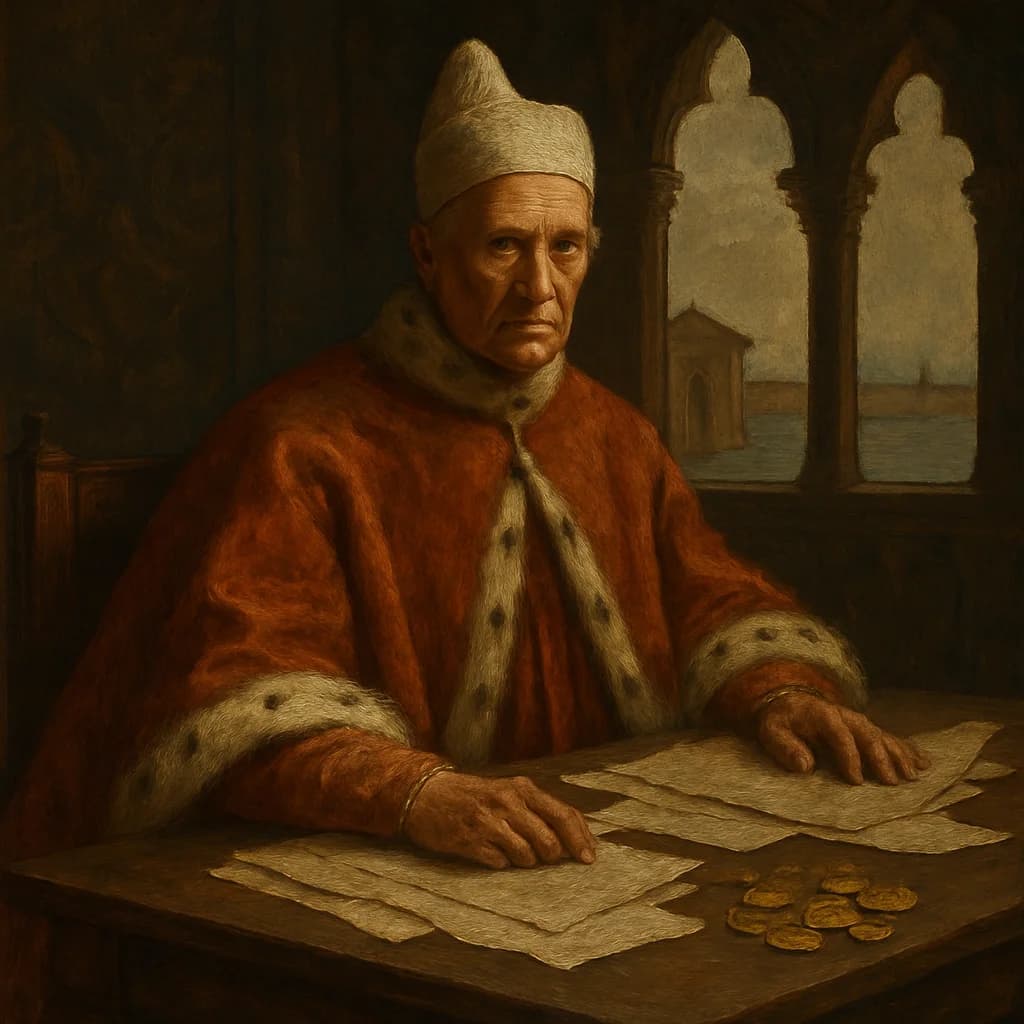
Pietro Ziani
The doge who turned Venice into Europe's first corporate state didn't start as a politician. He began as a merchant who understood that the real power lay not in palaces, but in ledger books.
Pietro Ziani inherited the Venetian dogeship in 1205 at a moment when most rulers were obsessed with castles and cavalry. Instead, he did something unprecedented: he ran the republic like a business. While other medieval leaders collected tribute through force, Ziani institutionalized Venice's transformation into what we'd recognize today as a multinational corporation, complete with overseas subsidiaries, diversified revenue streams, and ruthless efficiency.
His genius lay in understanding that Constantinople's fall during the Fourth Crusade wasn't just a military victory. It was a hostile takeover. Ziani systematically carved up the Byzantine Empire's commercial networks, installing Venetian trading posts like franchises across the Eastern Mediterranean. He didn't just want Venice to profit from trade; he wanted Venice to become trade itself. Under his rule, the republic developed the world's first standardized commercial law, maritime insurance systems, and double-entry bookkeeping that would later influence the Medici banks.
But Ziani's most radical innovation was treating citizenship like corporate membership. He formalized the Golden Book system that restricted political participation to merchant families who held shares in the state's trading ventures. Venice became a closed-loop economy where political power, commercial success, and social status were literally the same thing. Citizens weren't subjects. They were shareholders.
When Ziani died in 1229, he left behind something unprecedented in medieval Europe: a state that operated on pure capitalist principles three centuries before capitalism supposedly existed. His Venice didn't just trade with the world. It owned pieces of it, from Crete to Constantinople, each territory functioning as a profit center in history's first commercial empire.
Ziani established Venice's first state-sponsored espionage network, employing merchants as intelligence agents who reported back on foreign markets, political instability, and investment opportunities, essentially creating the world's first corporate intelligence service.
Why untold: Medieval historians focus on his military conquests rather than his revolutionary economic innovations, treating him as just another crusading doge instead of the architect of commercial capitalism.
When Sicily Sold Its Soul for Soap
A Venetian merchant's inventory list accidentally created Europe's most ruthless banking system, and destroyed an island paradise in the process.
A Fisherman's Lie to the Pope Made Venice Impossibly Rich
One man's desperate lie to the Pope set off a chain reaction that would reshape the medieval world and make Venice impossibly wealthy.
- Donald Nicol, Byzantium and Venice: A Study in Diplomatic and Cultural Relations
- Frederic C. Lane, Venice: A Maritime Republic
- Thomas F. Madden, Venice: A New History