
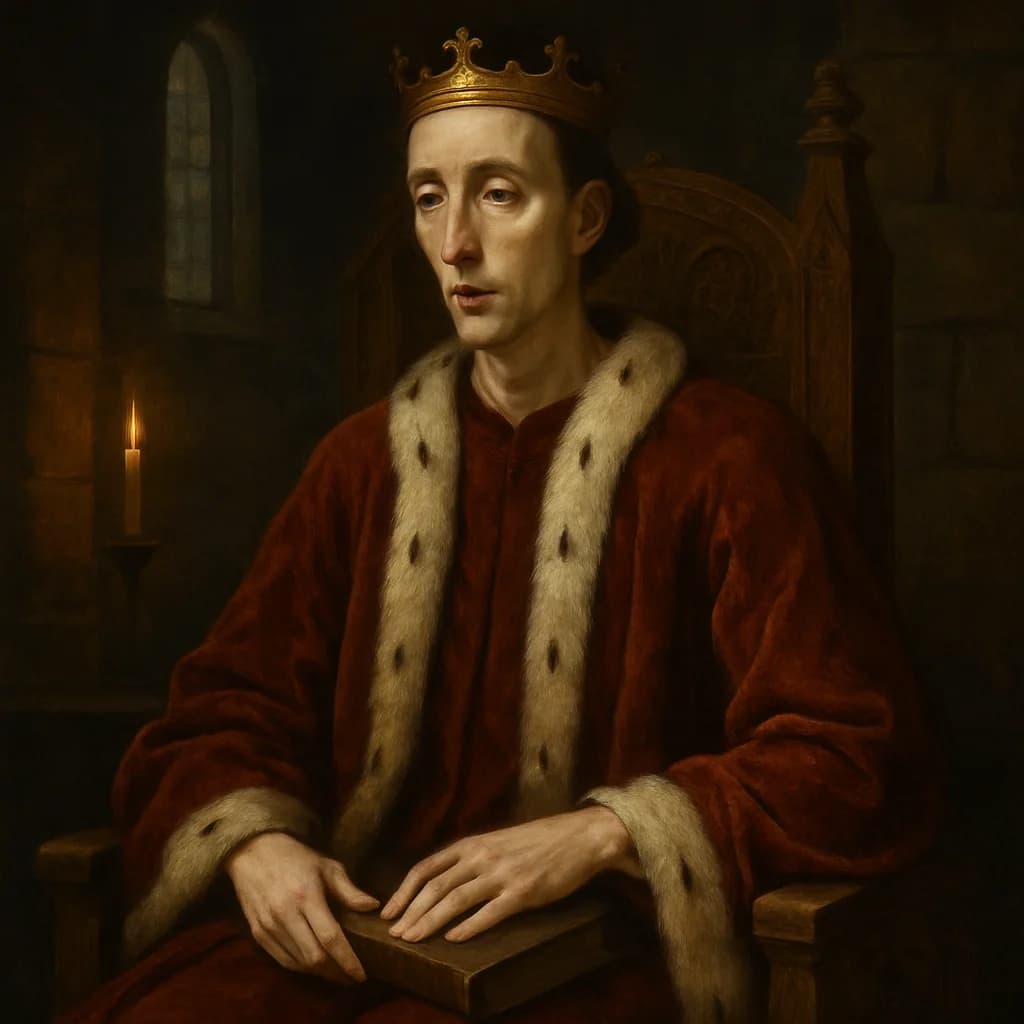
Henry VI
He inherited two kingdoms before he could walk, lost both before he could grow a beard, and spent the rest of his life being used as a prop by men who couldn't decide whether to crown him or kill him.
Henry VI became King of England at nine months old. Not a symbolic claim: an actual infant, held up in Westminster Abbey in 1422, technically sovereign over a country that had just watched his father conquer France. He would also inherit the French crown at two, making him the only person in history to be simultaneously proclaimed king of both nations. This was, from the very beginning, a life defined by what other people decided on his behalf.
What's rarely examined is how profoundly Henry's personality (or rather, the absence of a conventional royal one) shaped the catastrophe that followed. He was not stupid. He founded Eton College in 1440 and King's College, Cambridge in 1441, institutions still standing today, which suggests something more than vacancy. But he was constitutionally incapable of the central task of medieval kingship: violence. He reportedly wept at executions. He fainted at the sight of blood. He once walked in on a court entertainment featuring bare-shouldered dancers and fled the room in genuine horror. These are not the anecdotes of a man equipped to hold England together during the collapse of Lancastrian France.
The mental breakdown of 1453 is where history usually pauses. He went catatonic for eighteen months, couldn't speak, didn't recognize his own wife or newborn son. But what rarely gets said is that this breakdown arrived at the single worst possible moment: just as the last English territories in France were falling and Richard, Duke of York, was circling the throne. Power abhors a vacuum. The Wars of the Roses did not begin because men were ambitious. They began because the king stopped functioning, and no one had designed England for that.
He was deposed twice, restored once, and murdered in the Tower of London in May 1471, almost certainly on the orders of Edward IV. He was 49. His son had been killed at the Battle of Tewkesbury three weeks earlier. The Lancastrian line ended not with a battle but with a quiet disappearance: Henry VI died alone in a stone room, and the official cause given was 'melancholy.'
Henry VI was eventually canonized as a local saint by popular veneration. Pilgrims traveled to Windsor to pray at his tomb, and Henry VII lobbied Rome to make it official, though the formal canonization never came through.
Why untold: Henry VI is remembered as a pawn and a failure, which flattens the more unsettling truth: that his pacifism and genuine piety were not symptoms of weakness but a coherent worldview catastrophically mismatched to his office, a distinction historians rarely make because losers rarely get the benefit of interpretation.
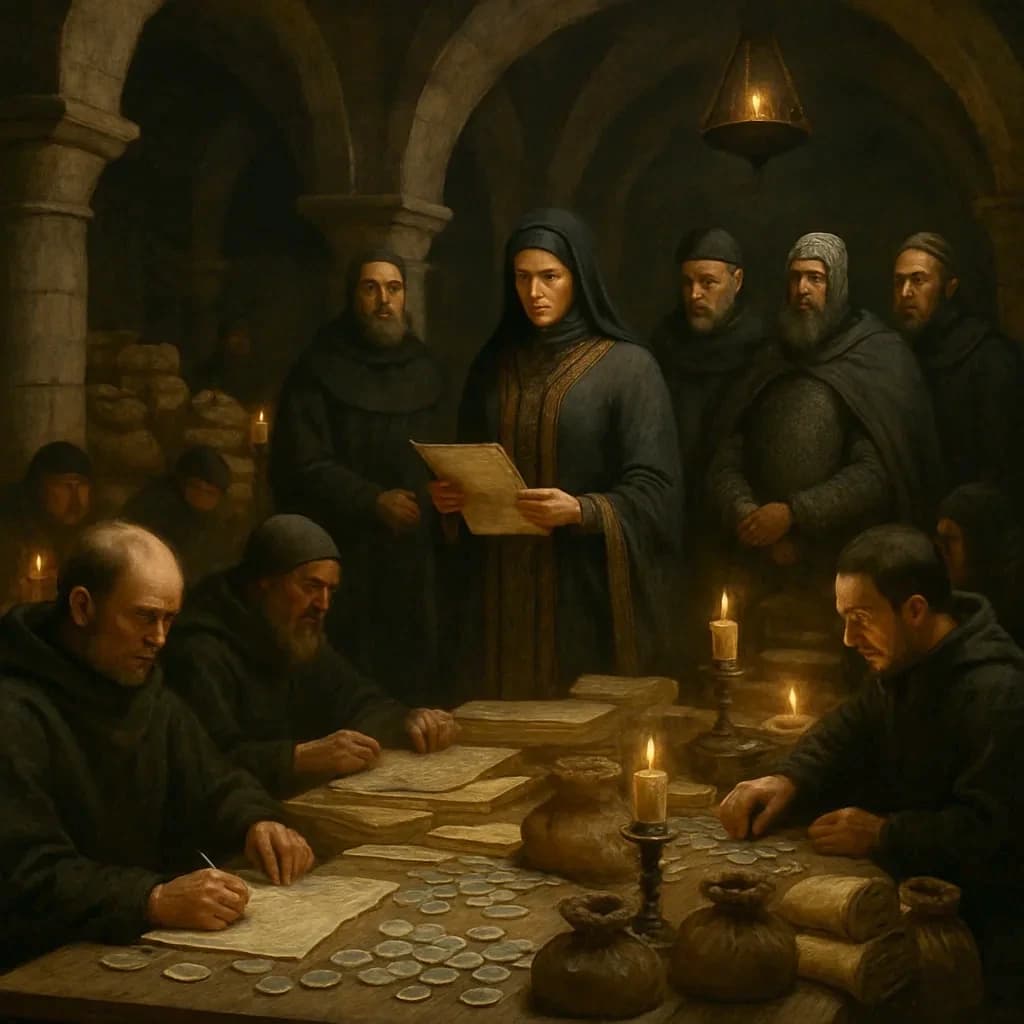
The Ransom That Cost England Three Years of Royal Revenue
Captured in disguise and held by an emperor, Richard I of England carried a price tag of 150,000 marks, and paying it quietly bankrupted a kingdom and taught its merchants that even a king could owe them money.
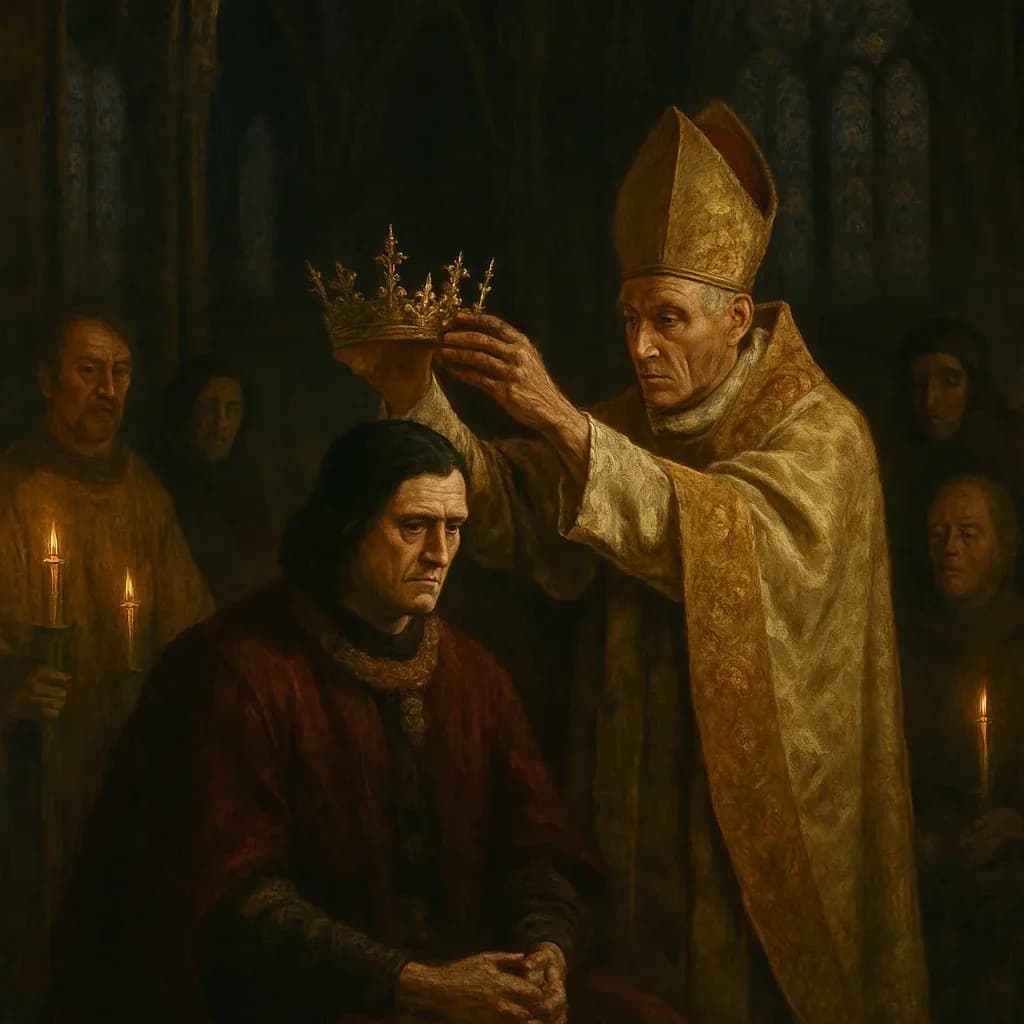
Two Princes Vanished: The Next King Hired Their Suspected Killer
In 1483, two princes vanished from the Tower of London, and the next king hired the same man who might have killed them.
- Bertram Wolffe, Henry VI (Yale English Monarchs series, 2001)
- Ralph A. Griffiths, The Reign of King Henry VI (University of California Press, 1981)
- John Watts, Henry VI and the Politics of Kingship (Cambridge University Press, 1996)