
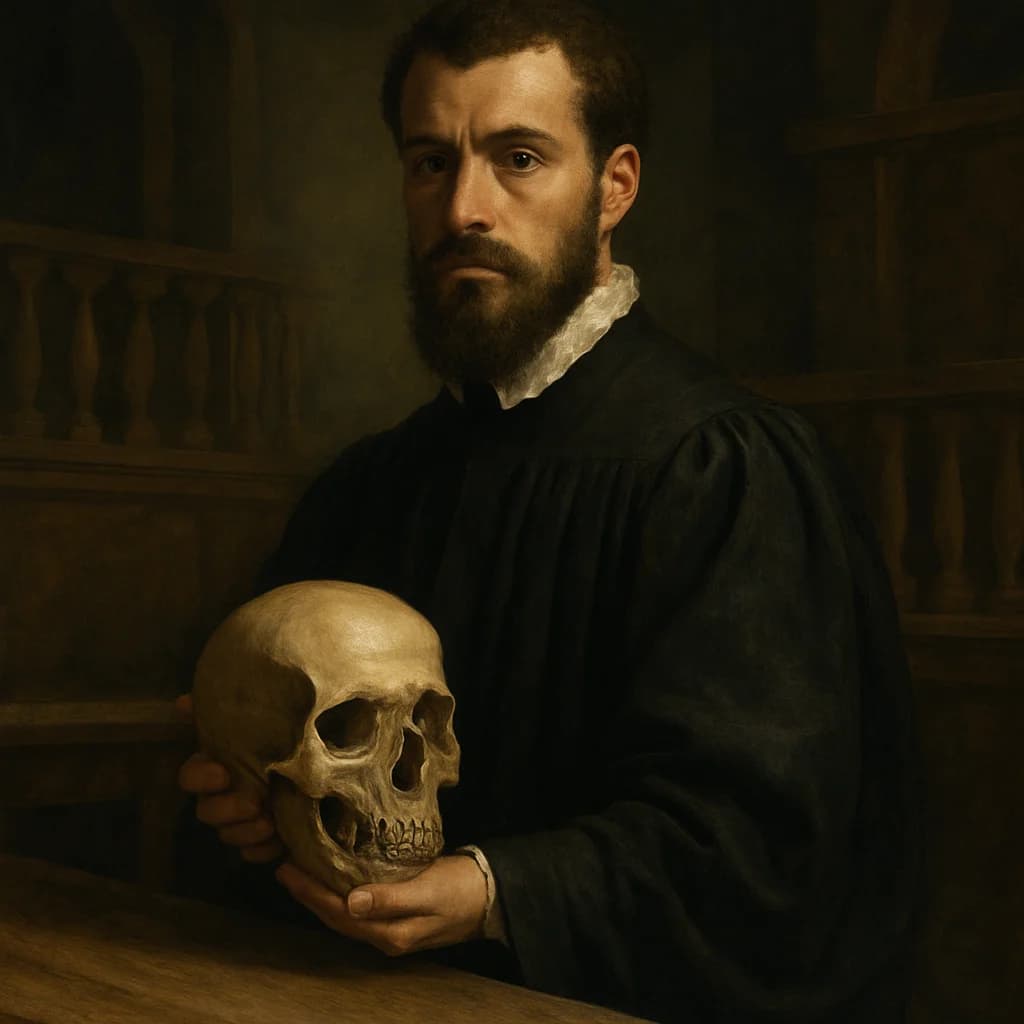
Andreas Vesalius
The most famous anatomist in history learned human anatomy by dissecting the wrong species for twenty years.
Andreas Vesalius arrived at the University of Padua in 1537 with a problem: everything he'd been taught about the human body was wrong. For over a millennium, medical students had memorized the anatomical teachings of Galen, the Roman physician who had never actually dissected a human corpse. Galen had built his entire understanding of human anatomy by cutting open apes, pigs, and dogs, then assuming humans looked the same inside.
Vesalius was supposed to follow tradition: stand at a lectern reading Galen's texts aloud while a barber-surgeon did the actual cutting and a demonstrator pointed at body parts. Instead, he picked up the knife himself. What he found horrified him. Human jaws had no gaps where Galen claimed they did. The human liver had no lobes that Galen described. The human heart had no holes that Galen insisted were there for blood to seep through.
At twenty-eight, Vesalius published 'De Humani Corporis Fabrica' in 1543, systematically dismantling fourteen centuries of medical orthodoxy. The book's detailed woodcut illustrations showed human anatomy as it actually existed, not as ancient texts claimed it should. The medical establishment erupted. His own former teacher, Jacques Sylvius, declared Vesalius a madman whose findings proved that human bodies had degenerated since Galen's time.
The backlash destroyed him. Facing accusations of heresy and grave robbing, Vesalius burned his remaining manuscripts and abandoned anatomy forever. He became court physician to Holy Roman Emperor Charles V, spending his final decades treating nobles' gout instead of revolutionizing medicine. He died at fifty, shipwrecked while returning from a pilgrimage to Jerusalem, possibly undertaken to escape the Inquisition's interest in his work.
Vesalius obtained corpses for dissection by stealing bodies from gallows outside Padua, sometimes having to fight off wild dogs for fresher specimens.
Why untold: His revolutionary impact gets overshadowed by the narrative that he simply 'corrected' Galen, obscuring how his hands-on approach fundamentally challenged the medieval hierarchy of knowledge itself.
The Surgeon Who Never Existed
For nearly four centuries, medical students across Europe learned their anatomy from a fictional character whose 'discoveries' were actually stolen from a woman.
Galen: The Roman Doctor Whose Cures Lasted 1,500 Years
The Roman Empire's most respected physician never performed surgery, never set a bone, and believed that wine could cure everything from broken hearts to broken legs.

Galen's Greek Original: The Book That Made Medicine Worse
A Greek scholar fled the fall of Constantinople in 1453 carrying the most important book in Europe, and nobody could read what it actually said.
- O'Malley, Charles Donald. Andreas Vesalius of Brussels, 1514-1564. University of California Press, 1964.
- Saunders, J.B. deC.M. and Charles D. O'Malley. The Illustrations from the Works of Andreas Vesalius of Brussels. World Publishing Company, 1950.
- Nutton, Vivian. Ancient Medicine. Routledge, 2004.