
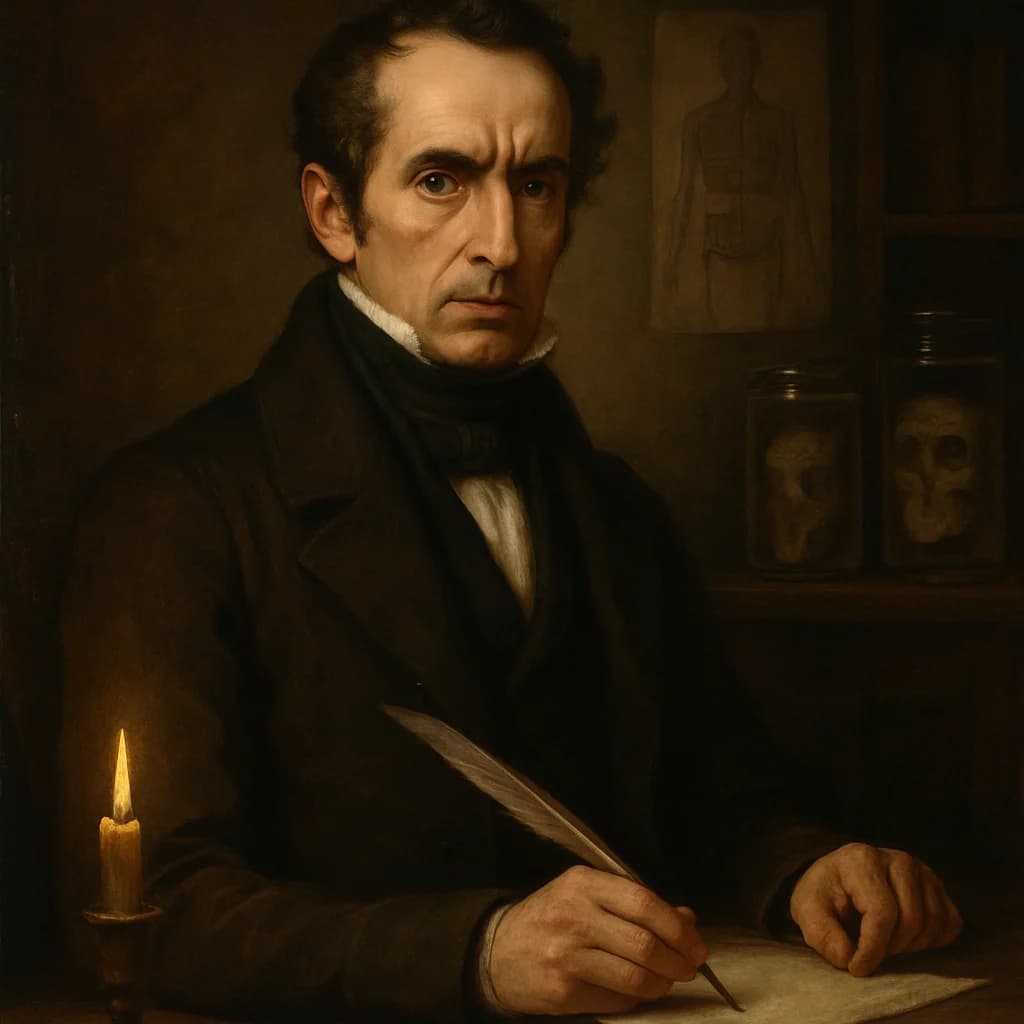
Robert Knox
He never touched a single corpse, and that's exactly what made him the most dangerous man in Edinburgh.
Robert Knox had been to places most men only read about in dispatches. He'd served as an army surgeon at Waterloo, catalogued animal species in Cape Town, studied under the finest anatomists in Paris. By the time he set up his private anatomy school at 10 Surgeons' Square in 1826, he was arguably the most brilliant comparative anatomist in Britain. His lectures drew five hundred students at a time, more than the entire University of Edinburgh medical faculty combined. He was brilliant, theatrical, and completely incurious about where his raw materials came from.
The body trade in Edinburgh was an open secret by the 1820s. The city's single anatomy school was legally entitled to the corpses of executed criminals, a supply that ran to perhaps a dozen bodies a year. Knox's school alone needed upwards of four hundred. What filled the gap was an informal economy of grave robbery, bribery, and shipping crates marked 'glass' moving south from Scottish churchyards to London dissection rooms. Knox knew this. Every anatomist knew this. He simply chose to treat procurement as someone else's administrative problem.
That someone else turned out to be William Burke and William Hare, who by 1827 had concluded that waiting for people to die naturally was inefficient. They murdered at least sixteen people and sold the bodies to Knox's school for fees ranging from £8 to £14 per corpse, decent money when a laborer earned less than £1 a week. Knox's doorman received the deliveries. Knox himself examined at least one body and noted it was 'remarkably fresh.' He asked no questions. When Burke was hanged in January 1829 and publicly dissected (the irony apparently lost on no one), a crowd of thirty thousand turned out. Knox was not formally charged with anything.
The subsequent inquiry cleared him of criminal involvement but destroyed him socially. Edinburgh's medical establishment, which had tolerated the body trade for decades, needed someone to absorb the scandal, and Knox was the obvious candidate. He spent the rest of his life in a slow professional exile: moving to London, taking work where he could find it, dying in 1862 as a consulting physician to a cancer hospital in Brompton, largely forgotten.
After the Burke and Hare scandal, a mob attacked Knox's house on Newington Place and burned an effigy of him outside, one of the few recorded cases in Scottish history of a scientist being subjected to a public effigy burning.
Why untold: Knox became the villain the city needed, allowing the medical establishment that had collectively depended on and tolerated the body trade for decades to avoid any institutional reckoning.
When Edinburgh's Dead Refused to Stay Buried
In 1820s Edinburgh, fresh corpses commanded higher prices than old masters, and desperate men would do anything to supply the demand.
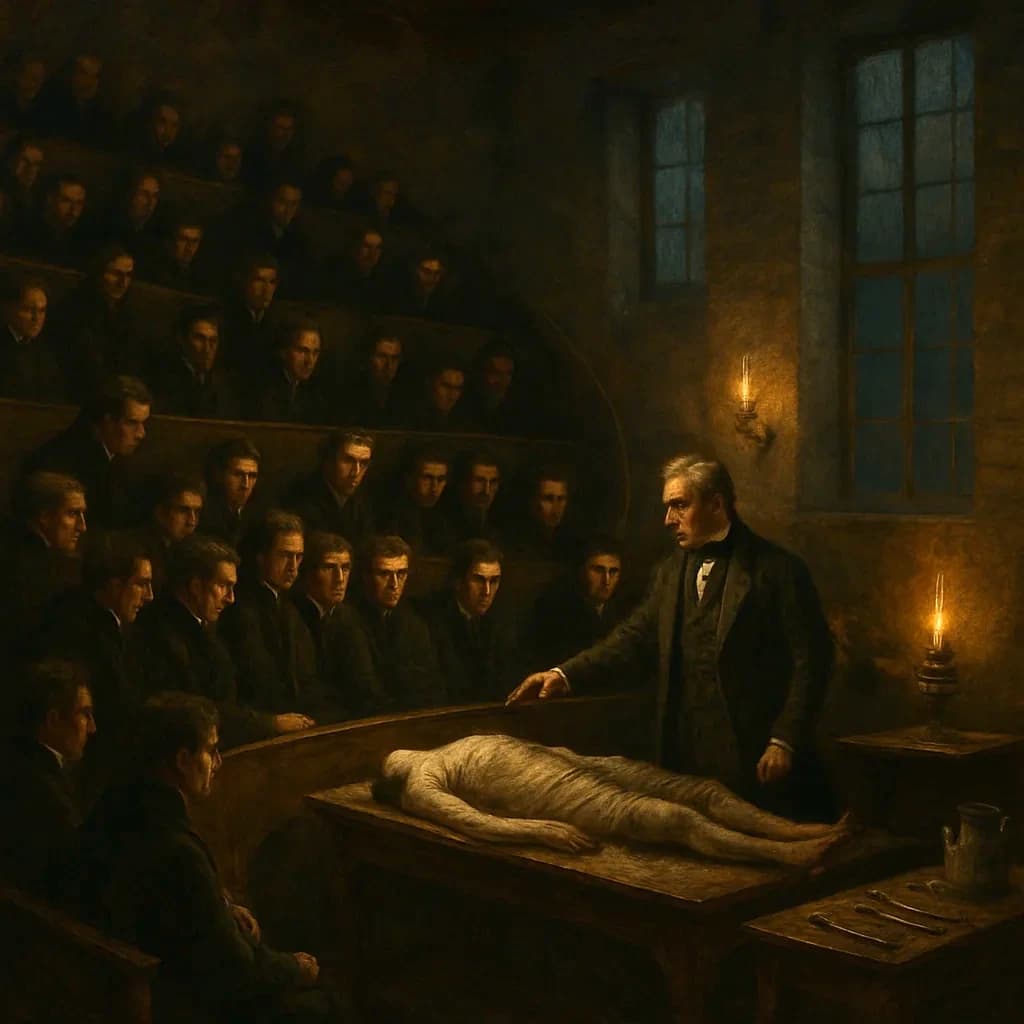
They Murdered to Fill the Dissection Table
A shortage of graves in Scotland's capital opened the most macabre business opportunity in history.
- Ruth Richardson, Death, Dissection and the Destitute (University of Chicago Press, 2000)
- Owen Dudley Edwards, Burke and Hare (Polygon, 1980)
- Rosner, Lisa, The Anatomy Murders: Being the True and Spectacular History of Edinburgh's Notorious Burke and Hare (University of Pennsylvania Press, 2010)