
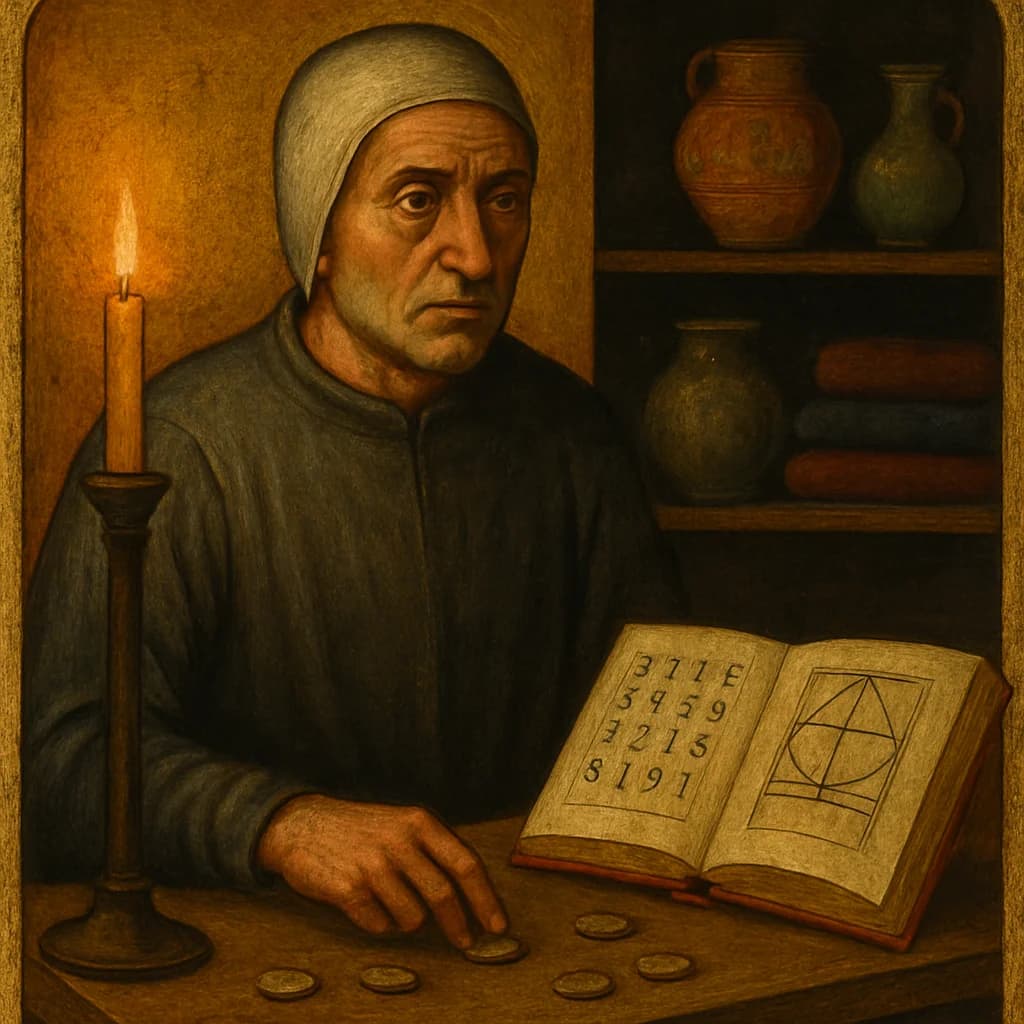
Leonardo Fibonacci
The man who gave Europe its numbers spent most of his life being ignored by Europe.
Leonardo of Pisa (Fibonacci, as later mathematicians would call him, a nickname he never used himself) was the son of a customs official stationed in the North African trading port of Bugia, in what is now Algeria. This detail tends to get lost. People imagine him in a Florentine tower, quill in hand, dreaming up rabbits. But his real education happened in the souks and counting houses of the Islamic Mediterranean, where Hindu-Arabic numerals had been standard commercial equipment for centuries. He grew up watching merchants calculate. He understood, viscerally, that the Roman numeral system wasn't just inelegant. It was a competitive liability. Try multiplying MCXLVII by CCLIX with no positional notation. Try running an empire on that.
He published Liber Abaci in 1202. It was not, by any measure, an overnight sensation. The book was a sprawling, ambitious argument for replacing Roman numerals with the Hindu-Arabic system, complete with worked examples in commercial arithmetic, currency conversion, and the famous rabbit problem that would eventually attach his name to a sequence he neither discovered nor particularly emphasized. The rabbit problem occupies maybe two pages of a 600-page manuscript. But the rest of the book (the parts about calculating profit margins, splitting contracts, computing interest), those parts mattered enormously to the Pisan merchant class. Just not immediately. Not for generations.
What's stranger is the silence around his later years. Holy Roman Emperor Frederick II (one of the most intellectually aggressive rulers of the medieval world) became fascinated with Fibonacci and arranged a mathematical tournament for him around 1225 in Pisa. Court mathematicians posed problems. Fibonacci solved them on the spot, including a cubic equation that his competitors couldn't touch. Frederick was reportedly delighted. After that, almost nothing. A small annual stipend from the city of Pisa, recorded in 1240. Then silence. No letters. No deathbed account. The exact year he died is unknown.
He essentially introduced the numerical foundation of Western commerce and science, received a modest municipal pension, and vanished. The sequence named after him wasn't called Fibonacci's sequence until 1877, when the French mathematician Édouard Lucas decided the connection deserved a name. By then, Leonardo of Pisa had been dead for six hundred years.
Fibonacci also wrote Liber Quadratorum in 1225, a sophisticated treatise on number theory that many historians consider his most brilliant work, yet it remained almost completely unstudied until the 19th century because no one had bothered to translate it.
Why untold: Because the one puzzle problem in a 600-page practical manual became the story, the name 'Fibonacci' arrived six centuries late, and the actual commercial and mathematical revolution he engineered got absorbed invisibly into the infrastructure of European trade with no famous founding moment attached.

Algebra Got a Pope Accused of Selling His Soul
Pope Sylvester II solved an equation that his enemies claimed proved he'd sold his soul to Satan.
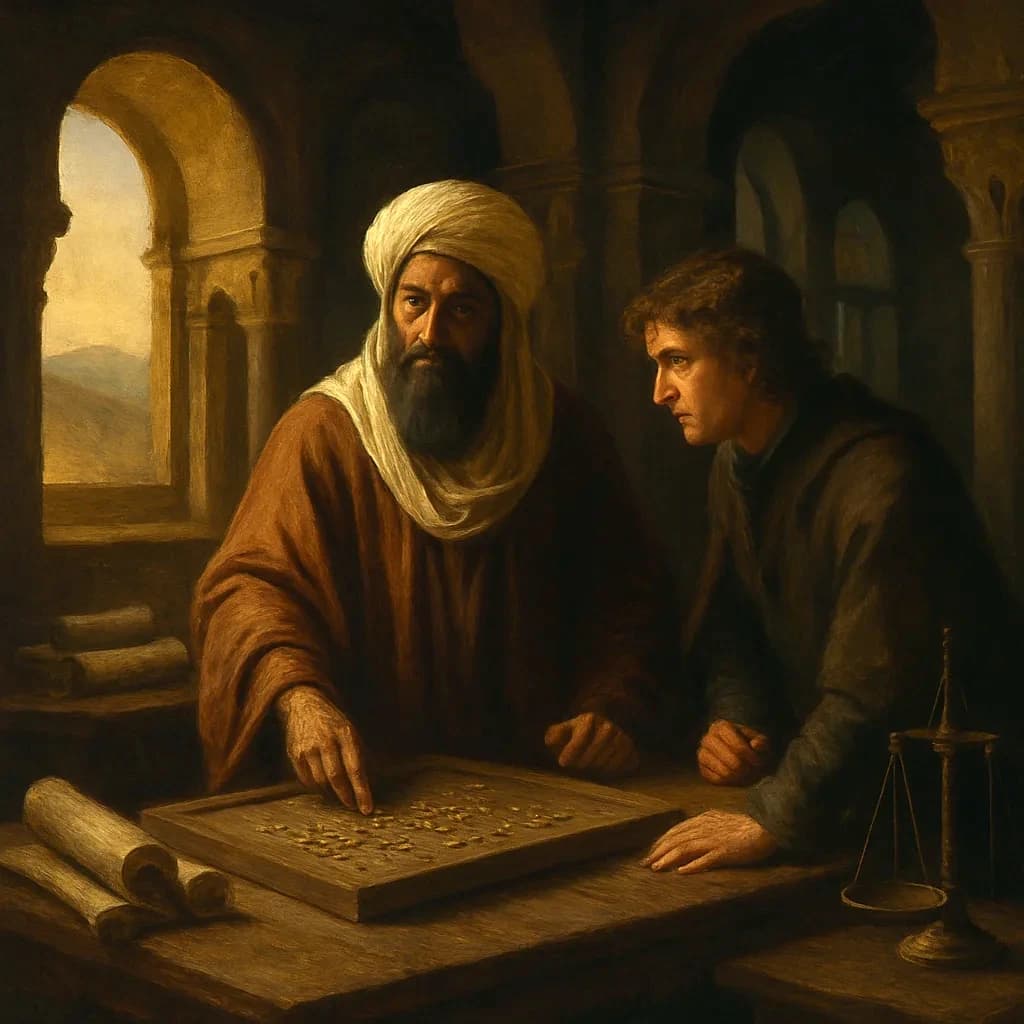
The Counting Trick That Built Banking Empires
A merchant's simple counting system in medieval Venice, watched by a curious Pisan in 1202, invented the mathematics that would bankrupt kings and build empires.

A Barber's Apprentice Cracked a Thousand-Year Mathematical Riddle
In 1494, a simple barber's apprentice in Pisa solved a mathematical riddle that had stumped scholars for a thousand years.

Zero: The Number Europe Tried to Ban
A scholar in 12th-century India made a calculation that would accidentally give birth to the modern world.
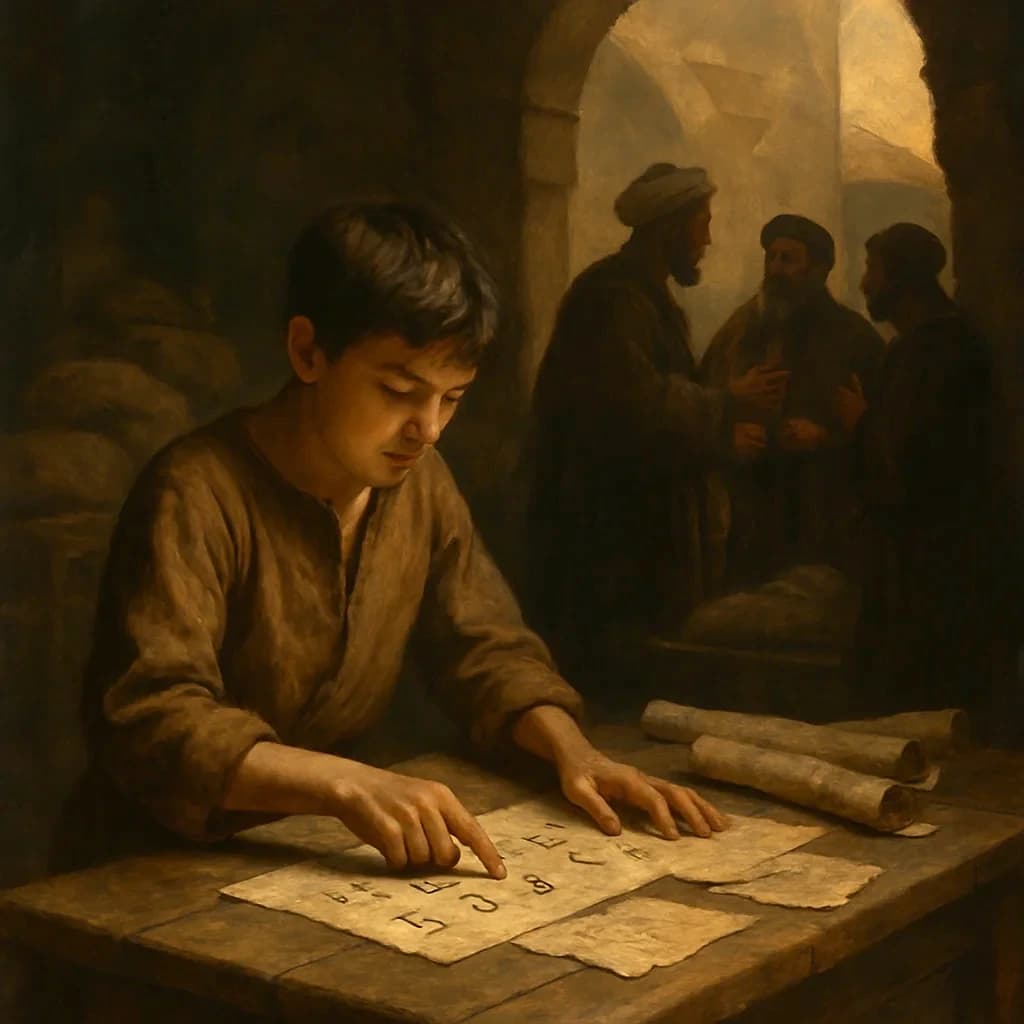
Fibonacci: How a Rabbit Puzzle Rewired Europe's Numbers
A teenage peasant boy discovered a mathematical pattern that would reshape astronomy, navigation, and commerce for five centuries, but nobody would believe him.

Banking by Fibonacci: How Florence Crashed Europe
A brilliant mathematician's obsession with perfect squares triggered one of history's most devastating financial collapses.
- Sigler, L.E. (trans.). Fibonacci's Liber Abaci: A Translation into Modern English of Leonardo Pisano's Book of Calculation. Springer, 2002.
- Devlin, Keith. The Man of Numbers: Fibonacci's Arithmetic Revolution. Walker & Company, 2011.
- Fibonacci, Leonardo. Scritti di Leonardo Pisano, ed. Baldassarre Boncompagni, 2 vols. Rome, 1857-1862.