
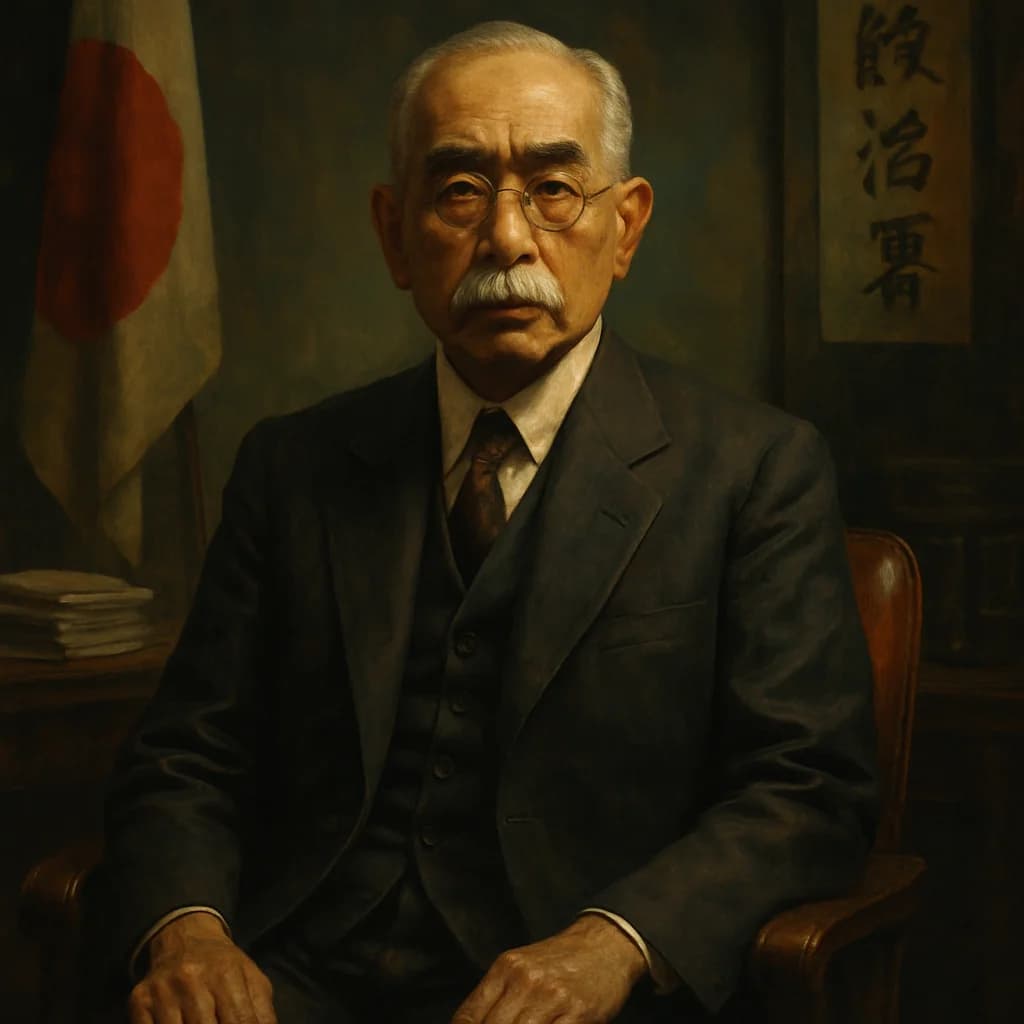
Kantaro Suzuki
The man who survived his own assassination became Japan's most reluctant prime minister, and his single word choice may have triggered the atomic bombs.
Kantaro Suzuki never wanted to be prime minister. By 1945, the 77-year-old admiral had already lived through enough history for three lifetimes. He'd commanded destroyers in the Russo-Japanese War, survived a point-blank assassination attempt in 1936 when military rebels pumped four bullets into him during the February 26 Incident, and spent years as a moderate voice warning against Japan's militaristic drift. When Emperor Hirohito personally asked him to lead Japan's government in April 1945, Suzuki reportedly wept.
The emperor chose Suzuki precisely because he was exhausted by war. Unlike the fire-breathing generals around him, Suzuki understood that Japan was finished. His naval background gave him credibility with the military, while his survival of the 1936 coup attempt (when younger officers tried to eliminate moderate voices) marked him as someone who'd already paid the price for reason. He spent his brief tenure as prime minister walking an impossible tightrope: appearing defiant enough to avoid another assassination while secretly maneuvering toward surrender.
Then came the Potsdam Declaration in July 1945. When reporters pressed Suzuki for Japan's response to the Allied ultimatum, he used the word "mokusatsu," a term that could mean anything from "no comment" to "treat with silent contempt." Whether he meant to reject the declaration outright or simply buy time for internal negotiations remains one of history's great ambiguities. American intelligence interpreted it as defiant rejection.
Three weeks later, Hiroshima burned. Suzuki spent his final days in office desperately trying to convince the emperor and military hardliners that surrender was inevitable, finally succeeding after Nagasaki. The man who'd spent decades avoiding the spotlight had stumbled into history's most terrible miscommunication.
Suzuki's wife found him bleeding out during the 1936 assassination attempt and told the attackers "If you're going to kill him, you'll have to kill me first," helping save his life by shaming the young officers.
Why untold: His crucial role in Japan's surrender is overshadowed by focus on the atomic bombs and MacArthur, while his complex navigation between peace and appearing strong enough to avoid assassination is rarely examined.
The Japanese Word America Read as Defiance
Japan was ready to negotiate an end to the Pacific War in 1945, and a single Japanese word may have guaranteed that it wouldn't.
The Mistranslated Word That Doomed Hiroshima
A translator's three-second hesitation in a Tokyo meeting room may have sealed the fate of Hiroshima and Nagasaki.
A Translator's Split-Second Word Choice May Have Doomed Hiroshima
A Japanese interpreter's split-second choice of words may have sealed the fate of Hiroshima and Nagasaki.
- Herbert Bix, Hirohito and the Making of Modern Japan (2000)
- Richard Frank, Downfall: The End of the Imperial Japanese Empire (1999)
- Kazutoshi Hando, Japan's Longest Day: The Last 24 Hours of World War II (2002)