
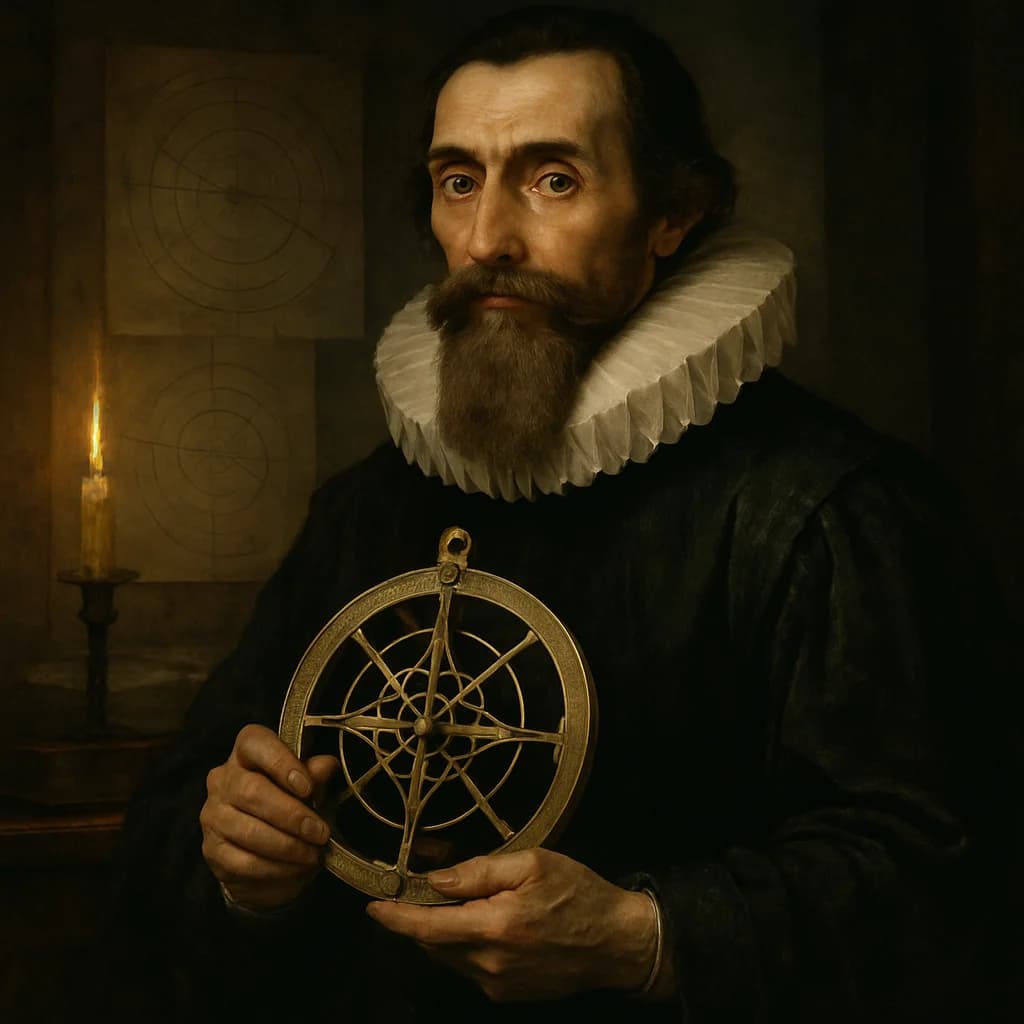
Johannes Kepler
The man who decoded the universe's secret language spent most of his life convinced he was going insane.
Johannes Kepler wrote horoscopes for a living. While revolutionizing astronomy, the man who discovered that planets move in ellipses (not perfect circles) cast astrological charts for emperors and noblemen to pay his bills. He genuinely believed the stars influenced human affairs, seeing no contradiction between mathematical precision and cosmic fortune-telling.
His path to celestial mechanics began with an obsession that bordered on madness. Kepler was convinced that God had hidden a musical harmony in planetary motion, that the universe literally sang. He spent years trying to match planetary speeds to musical intervals, filling notebooks with elaborate diagrams of nested geometric solids that he believed revealed the architecture of creation. His colleagues thought he'd lost his mind. They weren't entirely wrong.
The breakthrough came through tragedy and stubbornness. When his mentor Tycho Brahe died suddenly in 1601 (possibly from a burst bladder after refusing to leave a dinner party to urinate), Kepler inherited the most accurate astronomical observations in history. For eight grueling years, he tried to force Mars into a circular orbit. The math kept failing. Lesser minds would have blamed the data. Kepler blamed the universe, and discovered that planets move in ellipses.
Meanwhile, his personal life crumbled spectacularly. His first wife died young. His mother was accused of witchcraft. Kepler spent six years defending her in court, using mathematical arguments to prove she couldn't have cursed a neighbor's livestock. His salary was perpetually unpaid, forcing him to sell his horoscope services while writing the laws that govern celestial motion. He died traveling to collect back wages, still convinced he heard music in the mathematics of the spheres.
Kepler wrote the first work of science fiction, describing a journey to the moon guided by demons who could withstand the vacuum of space.
Why untold: His mystical obsessions and astrological practice are omitted from textbooks that prefer clean narratives of scientific rationality.
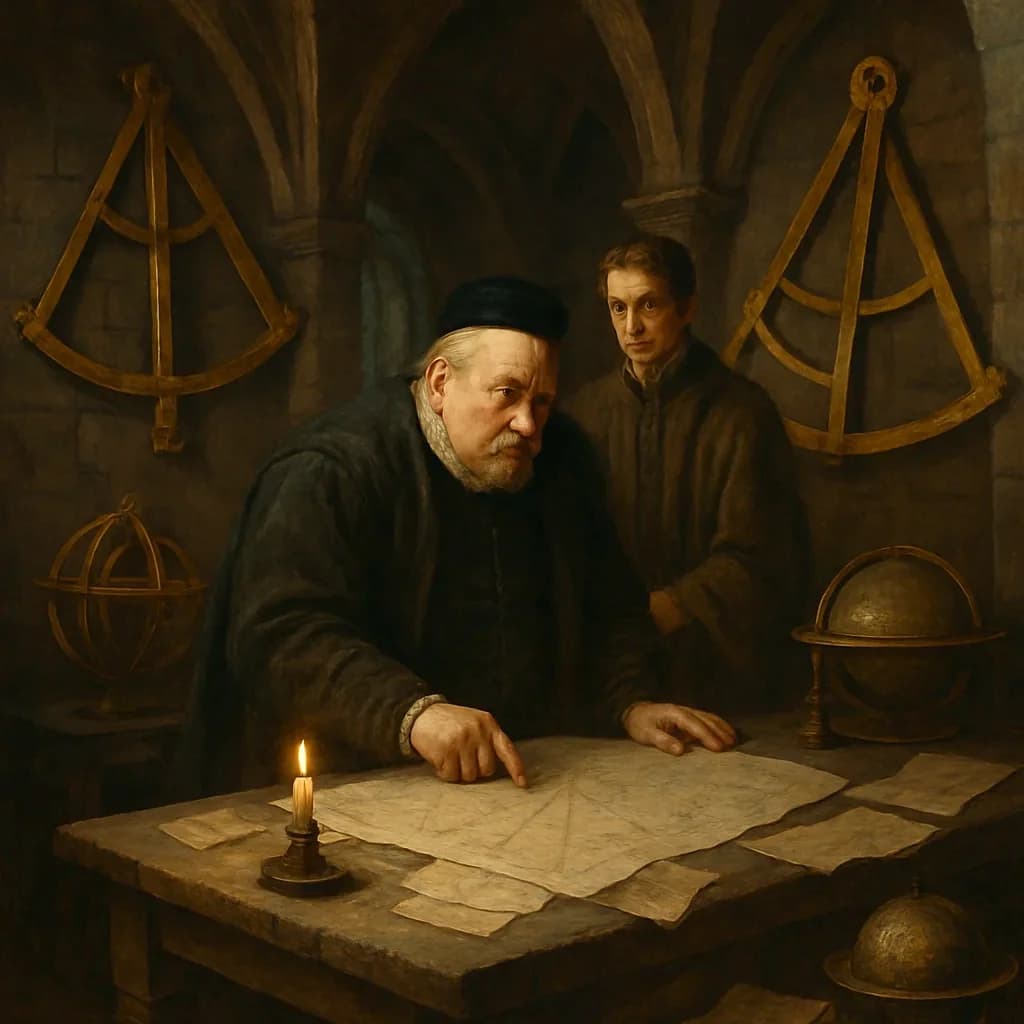
The Man Who Could Have Saved Giordano Bruno Stayed Silent
A broke and desperate Giordano Bruno burned at the stake in 1600, and the man who might have saved him chose, at the last moment, to stay silent.
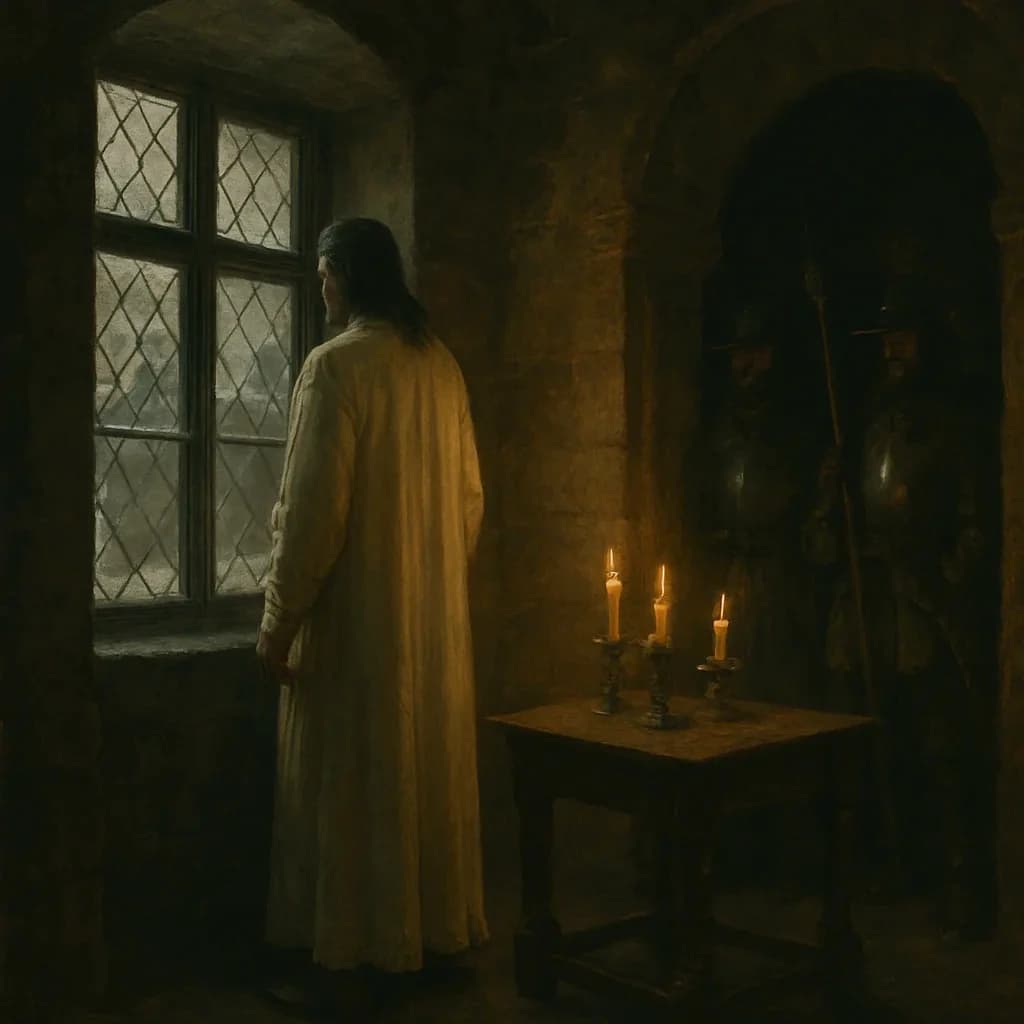
The General His Own Emperor Had Killed
Wallenstein commanded the largest private army in European history, and a single astrologer's chart decided whether he lived or died.
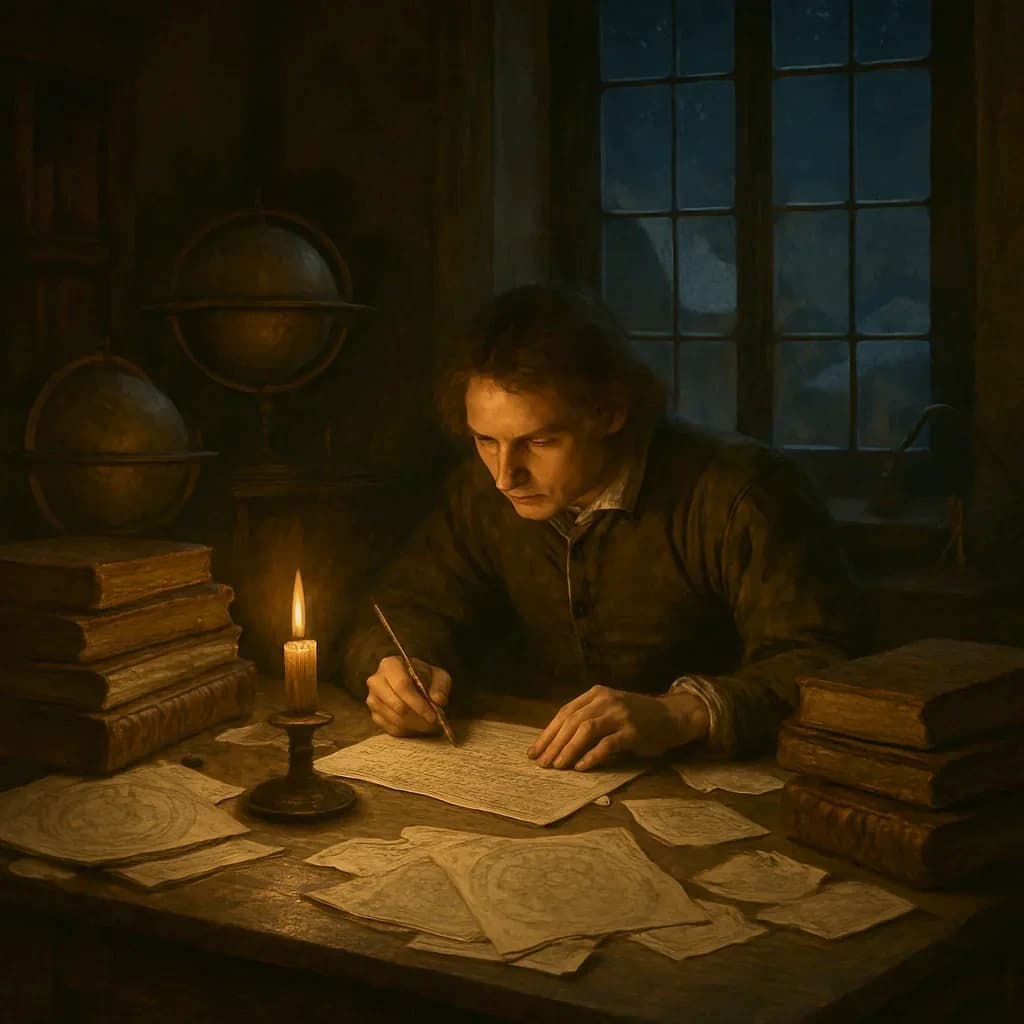
Kepler Needed a Dead Man's Numbers
A Danish astronomer's widow held the only complete copy of data that would prove the Earth moved around the Sun, and she refused to hand it over.

The Dishwater That Solved the Planets' Mystery
A servant girl washing dishes in Prague solved a puzzle in 1619 that had stumped Europe's greatest minds for two centuries.
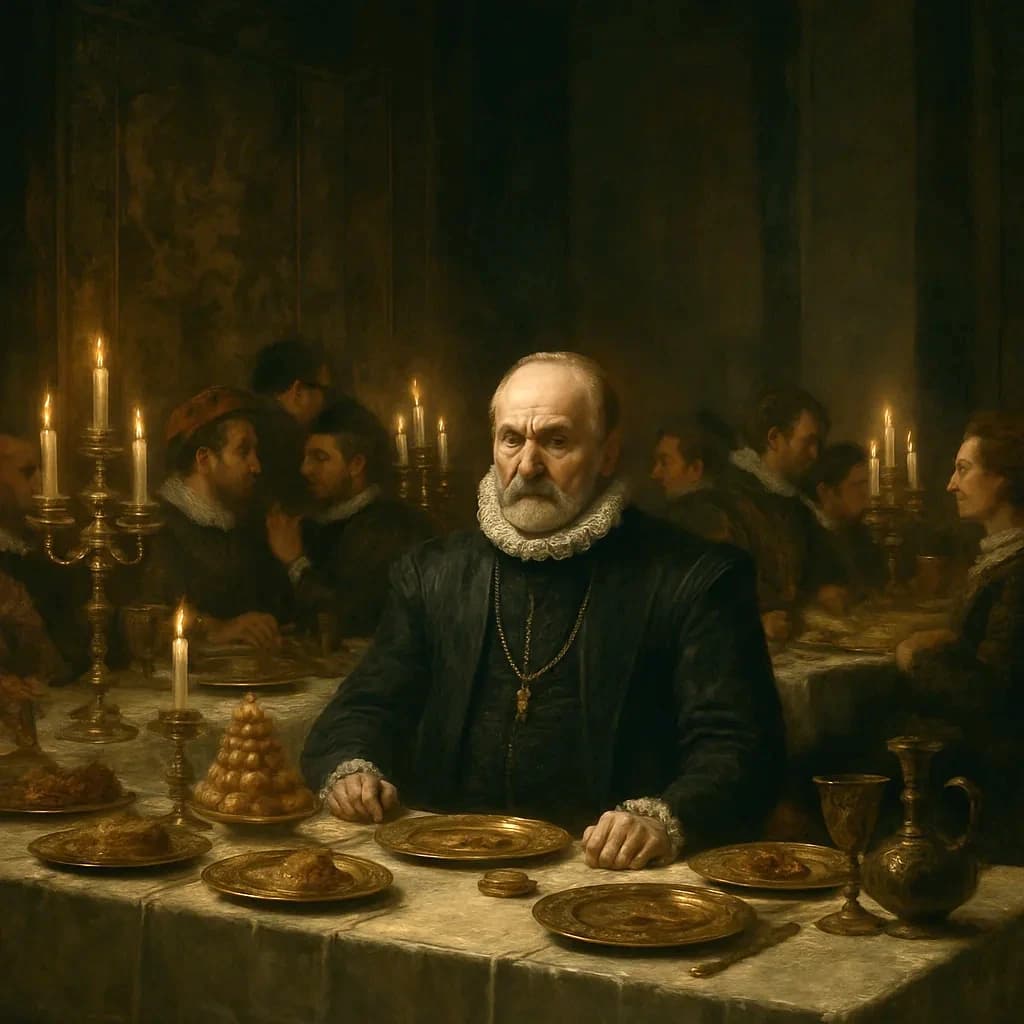
Tycho Brahe Wouldn't Leave the Emperor's Table
A Danish nobleman's bizarre death at a 1601 dinner party changed how we see the universe forever.
- Arthur Koestler, The Sleepwalkers: A History of Man's Changing Vision of the Universe
- James Voelkel, Johannes Kepler and the New Astronomy
- Kitty Ferguson, Tycho & Kepler: The Unlikely Partnership That Forever Changed Our Understanding of the Heavens