

Girolamo Fracastoro
He named syphilis, theorized germ disease a century before microscopes could prove him right, and almost nobody outside a medical library has heard of him.
Girolamo Fracastoro was born in Verona around 1478 into the kind of Renaissance that actually existed, not the sanitized version of art and philosophy, but one reeking of plague, pox, and physician's fees. He studied at Padua alongside Copernicus, which is the kind of sentence that should stop you cold. Two of the most consequential scientific minds of the sixteenth century sat in the same lecture halls, breathed the same air, and both walked out carrying ideas that would take centuries to fully land.
Fracastoro's most famous act was writing a Latin poem in 1530 called Syphilis sive morbus gallicus ('Syphilis, or the French Disease'), which gave the illness its permanent name by way of a fictional Greek shepherd who angered Apollo and was cursed with festering sores. Medical nomenclature via mythological poetry. The Renaissance was a strange place. But the poem was also a delivery mechanism for something more serious: a meditation on contagion, on how disease moves through populations, on invisible agents that transfer sickness between bodies. He called them seminaria: seeds of disease.
Twenty years later, in 1546, he published De Contagione et Contagiosis Morbis, a systematic theory of epidemic disease that described three modes of transmission: direct contact, contaminated objects he called fomites, and transmission at a distance. The word 'fomites' is still in use in modern epidemiology. He wrote it in 1546. Without a microscope. Without germ theory. Without any of the conceptual infrastructure that would eventually justify his conclusions. He was working almost entirely from observation and an unusually disciplined refusal to accept supernatural explanations for physical phenomena.
He was also an astronomer, a geographer who contributed to early cartography, a poet of some reputation, and the personal physician to Pope Paul III. He died in 1553 in Caffi, near Verona, reportedly of a stroke, quickly, which for a Renaissance physician who had spent a lifetime surrounded by syphilis patients and plague outbreaks reads almost like a reward.
Fracastoro's concept of 'fomites' (inanimate objects capable of carrying and transmitting disease) was coined in 1546 and remains the standard medical term used in infection control protocols today.
Why untold: Because Fracastoro's germ theory arrived without the microscopic evidence needed to validate it, history filed him under 'proto-scientist' rather than pioneer, and the credit ultimately flowed to Pasteur and Koch three centuries later when the tools finally caught up to the idea.
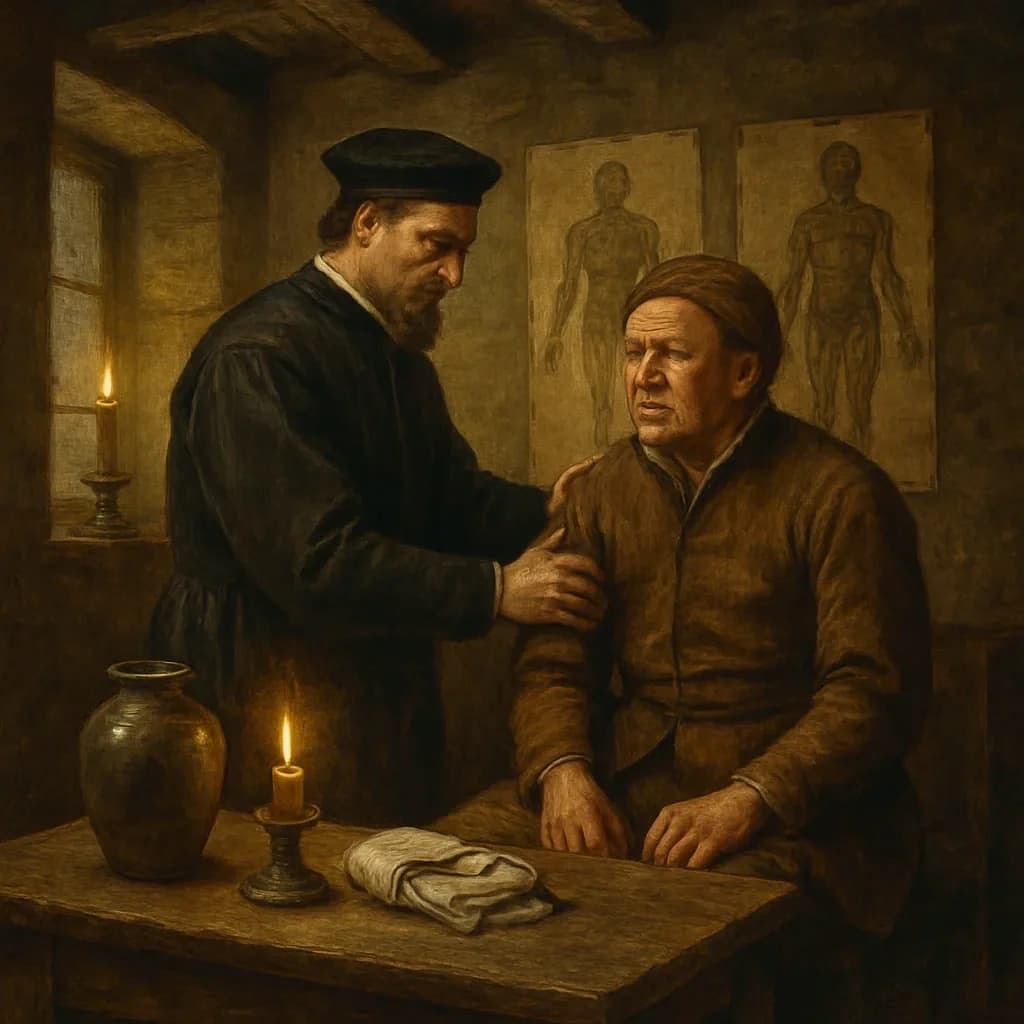
Doctors Treated Syphilis With Mercury for Four Centuries
For four centuries, European doctors treated syphilis with mercury, and killed nearly as many patients as the disease did.

Mercury: The Syphilis Cure That Poisoned the Renaissance
A Venetian doctor's brilliant cure for syphilis became Europe's deadliest addiction.

An Apprentice's Lens Knocked Earth From the Center of the Universe
A Venetian glassmaker's apprentice stumbled upon a lens that would eventually move the Earth from the center of the universe.
- Nutton, Vivian. 'The Seeds of Disease: An Explanation of Contagion and Infection from the Greeks to the Renaissance.' Medical History 27, no. 1 (1983): 1-34.
- Fracastoro, Girolamo. De Contagione et Contagiosis Morbis et Eorum Curatione. Translated by Wilmer Cave Wright. New York: G.P. Putnam's Sons, 1930.
- Pennuto, Concetta. 'The Debate on Contagion and Sympathy in Fracastoro's Thought.' In Girolamo Fracastoro: Fra Medicina, Filosofia e Scienze della Natura, edited by Alessandro Pastore and Enrico Peruzzi. Florence: Olschki, 2006.