
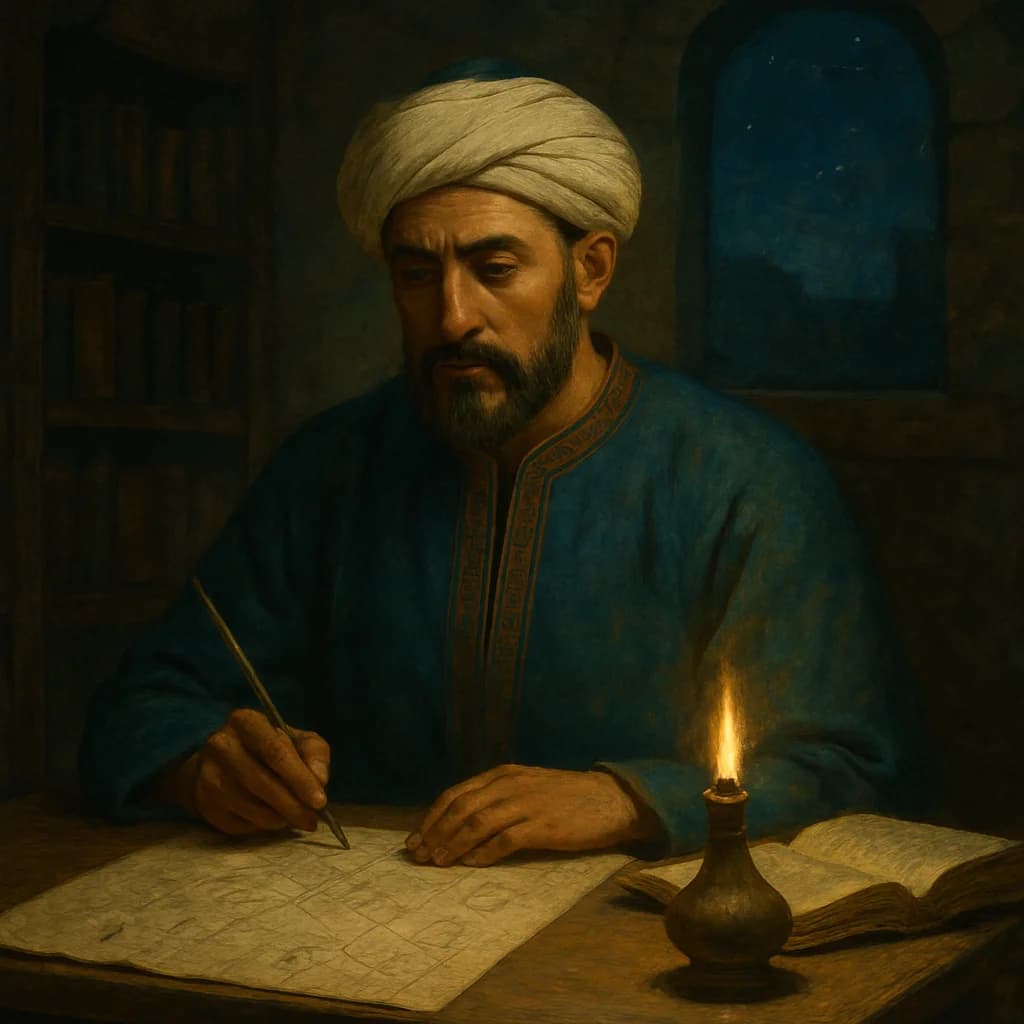
Al-Khwarizmi
The man who invented algebra didn't think he was inventing mathematics. He thought he was writing a practical guide for divorced people.
Muhammad ibn Musa al-Khwarizmi was born sometime around 780 CE, probably in the Khwarazm region southeast of the Aral Sea, and died around 850 CE having quietly reshaped the cognitive architecture of the entire human species. He would not have put it that way. He was modest to the point of near-invisibility, a scholar embedded in the House of Wisdom in Baghdad under Caliph al-Ma'mun, and what he wanted (what he actually said he wanted) was to give ordinary people a tool for solving problems about inheritance disputes, land surveying, and the division of property after divorce. The book he wrote to accomplish this was called Al-Kitab al-mukhtasar fi hisab al-jabr wal-muqabala. The word jabr, meaning the reunion of broken parts, would eventually become algebra.
Here is the part that never makes it into the textbooks: al-Khwarizmi almost certainly could not have written that book without Indian mathematicians he never met. He was working as a translator and synthesizer as much as an inventor, pulling the Hindu numeral system (including the radical concept of zero as a placeholder) through an Arabic intellectual filter and handing it to the world in a form Europeans could eventually receive. When his works were translated into Latin in the 12th century, scribes latinized his name as Algoritmi. The procedures he described became known as algorithms. He has been living inside your phone this entire time.
But the geography of his erasure is specific. The Baghdad that housed him was the largest city on earth, a metropolis of perhaps a million people running institutions (paper mills, observatories, translation bureaus) that Europe would not replicate for centuries. When the Mongols sacked Baghdad in 1258, they destroyed the House of Wisdom and reportedly turned the Tigris black with ink from its libraries. The physical continuity of that intellectual world was severed. What survived, survived through Latin translations made by Europeans who had no particular interest in crediting the civilization they were mining.
What al-Khwarizmi actually looked like, whether he was religious or skeptical, whether he had children: essentially nothing personal is known. He left behind books and a ghost of a name embedded in every algorithm ever run. The invisibility is nearly perfect.
Al-Khwarizmi also wrote one of the medieval world's most accurate geographies, correcting Ptolemy's coordinates for over 2,400 locations, a project that required him to oversee a measurement of one degree of terrestrial latitude by sending teams of surveyors into the desert with measuring ropes.
Why untold: The Mongol destruction of Baghdad in 1258 severed the institutional memory of the House of Wisdom, and subsequent Latin translators absorbed al-Khwarizmi's work into European intellectual tradition without preserving his origin, leaving his name fossilized in the word 'algorithm' while the man himself dissolved into anonymity.
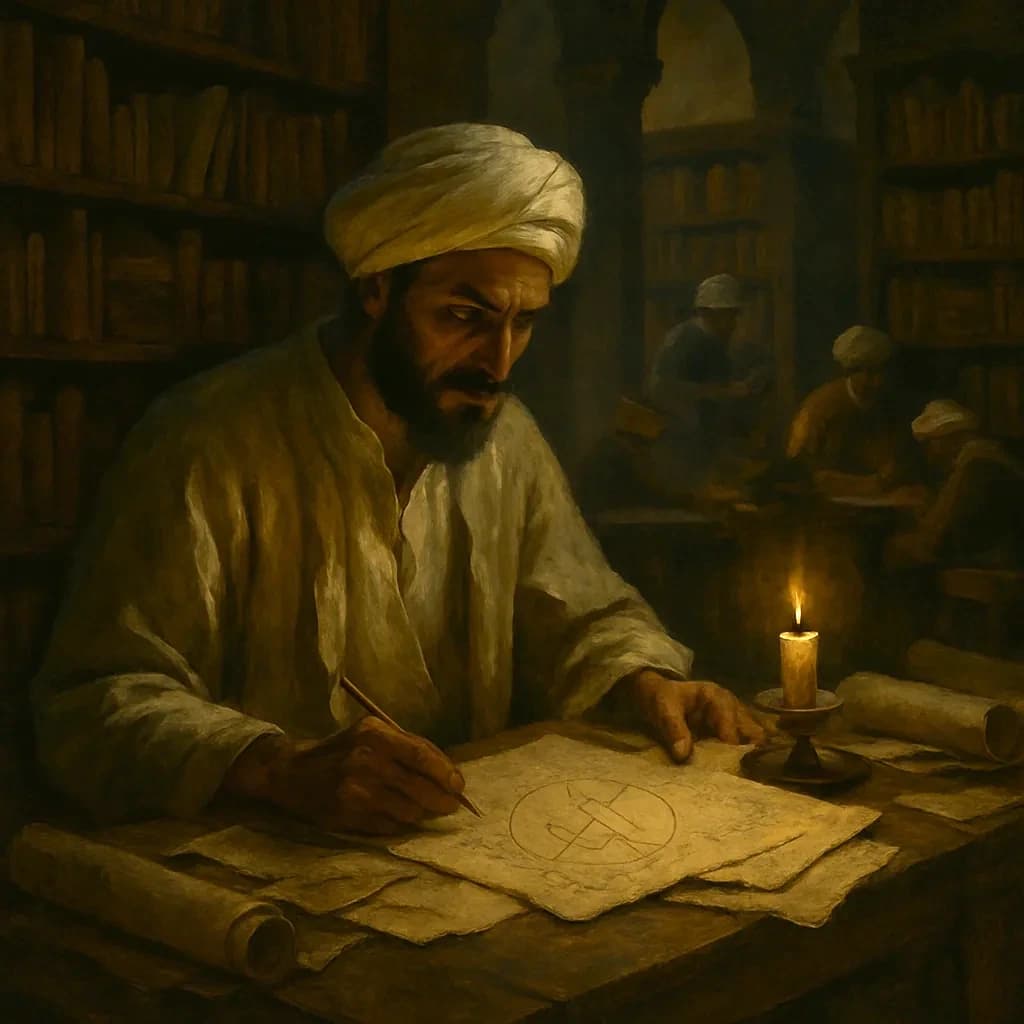
Zero: How a Baghdad Scholar Made Nothing Count
A Persian mathematician's midnight calculation in Baghdad changed how humans think about numbers, but no one knows his name.
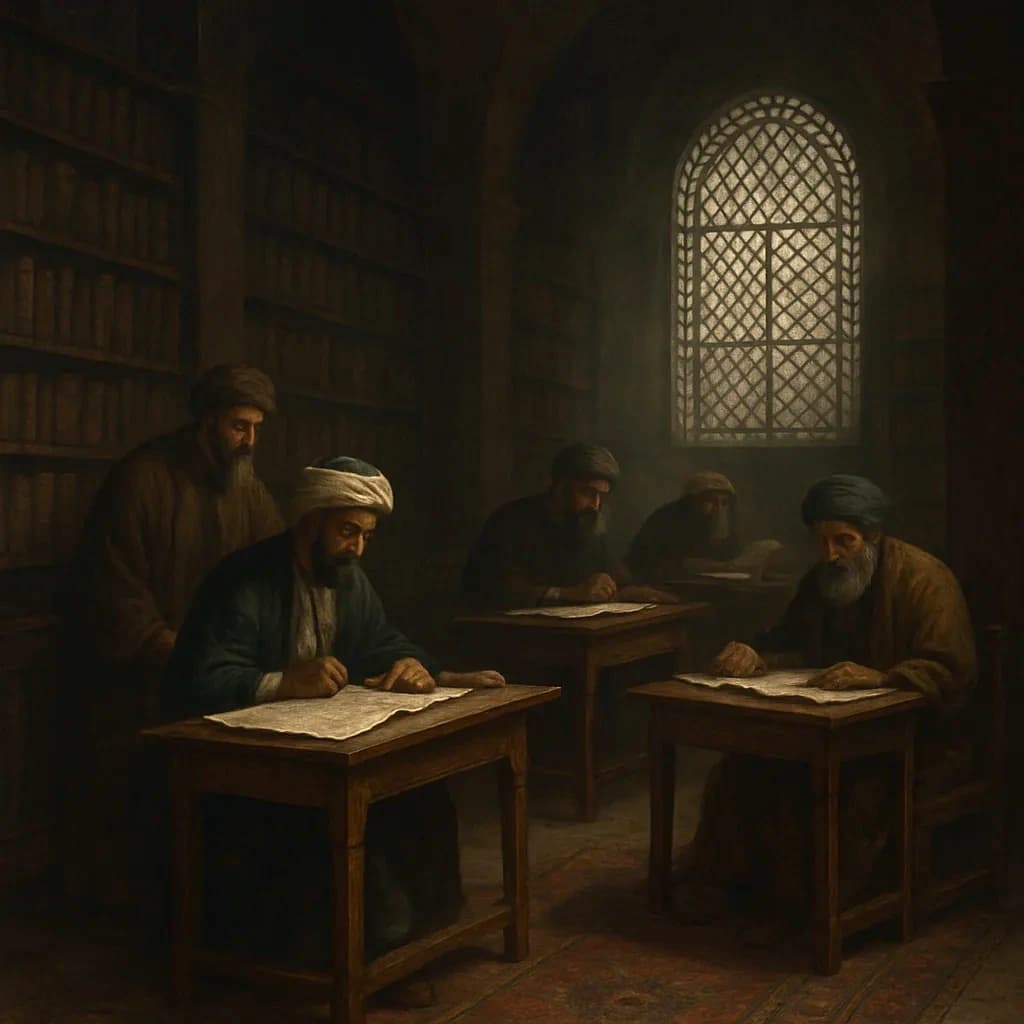
When Baghdad Was the Smartest City on Earth
While Europe struggled through the Dark Ages, one Mesopotamian city ran the world's first hospitals, universities, and paper mills, then vanished from history.
- Roshdi Rashed, 'The Development of Arabic Mathematics: Between Arithmetic and Algebra' (Kluwer, 1994)
- Jim Al-Khalili, 'The House of Wisdom: How Arabic Science Saved Ancient Knowledge and Gave Us the Renaissance' (Penguin, 2011)
- Frederic Rosen, trans., 'The Algebra of Mohammed ben Musa' (Oriental Translation Fund, London, 1831): first English translation of al-Kitab al-mukhtasar