
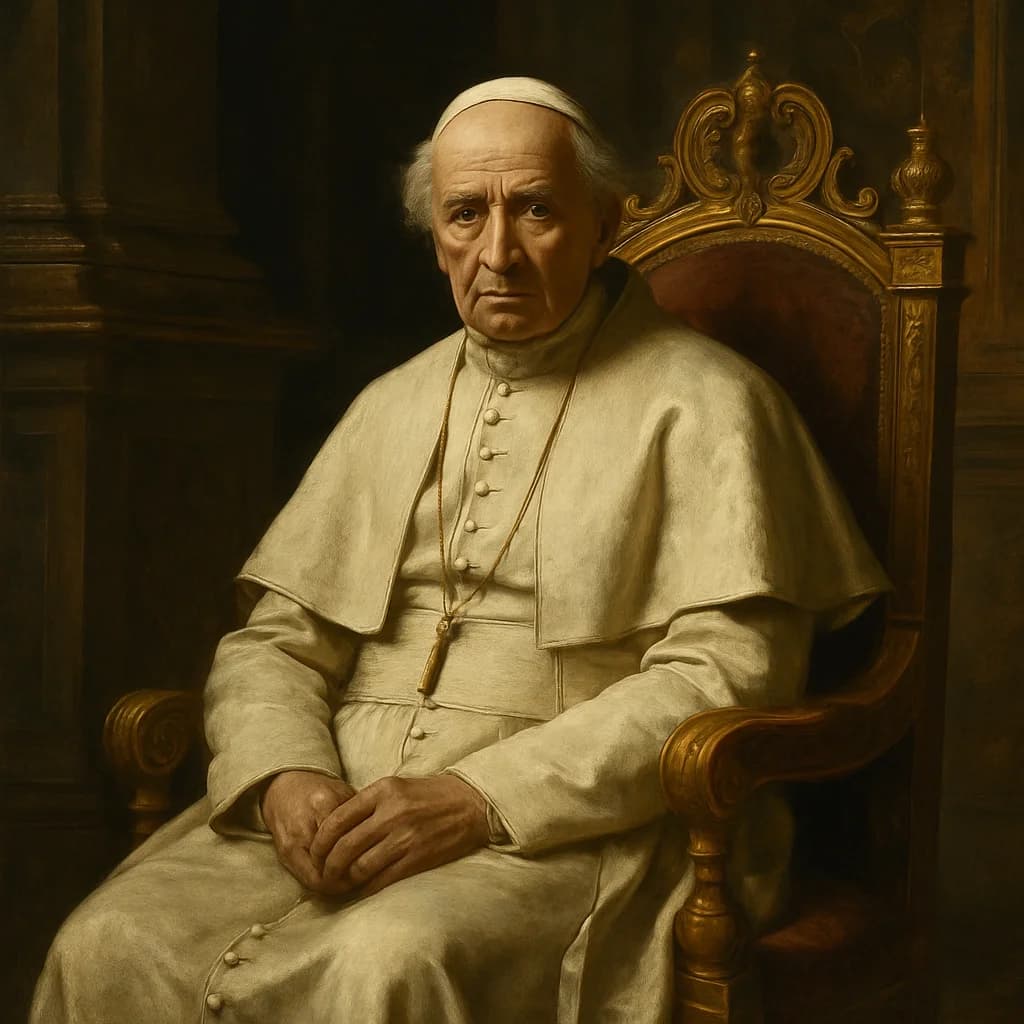
Pope Pius IX
The longest-reigning pope in history spent three decades as a literal prisoner in his own palace, refusing to set foot outside the Vatican after Italian soldiers seized Rome.
Giovanni Mastai-Ferretti seemed destined for obscurity. Born to minor nobility in 1792, he suffered from epilepsy so severe that church law initially barred him from ordination. Only a personal dispensation from Pope Pius VII allowed him to become a priest in 1819. Yet this sickly young man would become Pius IX, occupying the papal throne for thirty-one years and transforming the Catholic Church more radically than any pontiff since the Counter-Reformation.
Elected in 1846 as a liberal reformer, Pius IX began by freeing political prisoners and modernizing the Papal States. Romans celebrated in the streets. But the revolutions of 1848 shattered his faith in progress forever. When Roman republicans forced him to flee the city in disguise, the traumatized pope returned a changed man. The liberal became an absolute monarchist, the reformer an unwavering traditionalist.
The transformation culminated in 1870 when Italian forces breached Rome's ancient walls. Rather than accept the new reality, Pius IX declared himself 'the Prisoner of the Vatican' and never again left the papal enclave. For eight years, he refused all contact with the Italian state, turning the papacy into a self-imposed exile. He died in 1878, still claiming temporal sovereignty over territories that no longer existed.
Yet his greatest legacy wasn't political but theological. In 1854, he proclaimed the Immaculate Conception as dogma, the first new Catholic doctrine in centuries. Later, the First Vatican Council under his leadership declared papal infallibility, forever changing how Catholics understood religious authority. The epileptic boy who nearly couldn't become a priest ended up claiming divine immunity from error.
Pius IX's body was nearly thrown into the Tiber River in 1881 when an anti-clerical mob attacked his funeral procession as it moved from the Vatican to his burial site.
Why untold: His political defeats overshadowed his theological revolution, which fundamentally reshaped modern Catholicism's relationship with authority and doctrine.
Coca Wine: How a Monk's Recipe Reached Freud
A secret ingredient list for coca wine vanished from a Parisian monastery and sparked a medical revolution that would terrify the Catholic Church for a century.
A Phrase No Peasant Girl Should Have Known
A teenage girl's supernatural visions convinced the Catholic Church to add an entirely new doctrine, but the real miracle was how she survived the investigation.
- David Kertzer, 'The Pope and Mussolini: The Secret History of Pius XI and the Rise of Fascism in Europe'
- Frank J. Coppa, 'The Modern Papacy, 1798-1995'
- Owen Chadwick, 'A History of the Popes 1830-1914'