
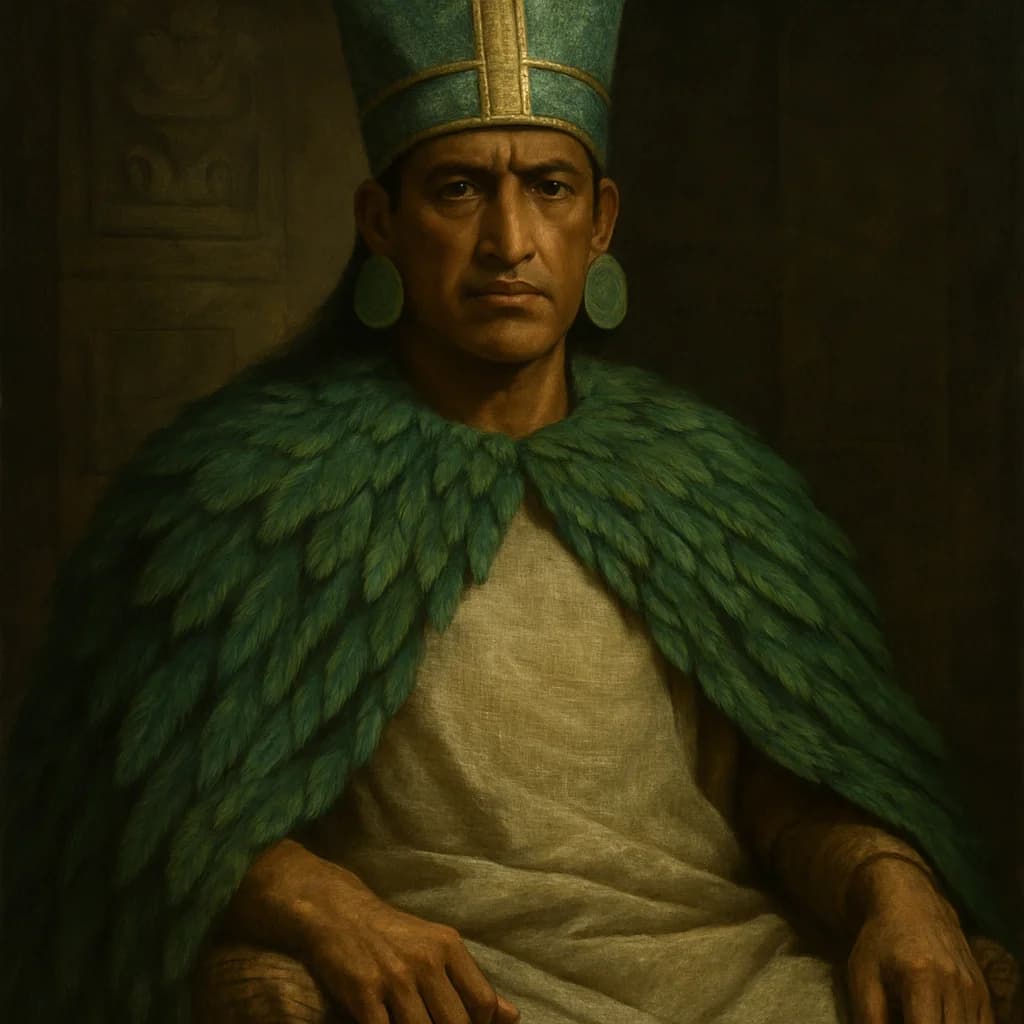
Moctezuma II
He ruled the most powerful empire in the Americas from a floating litter, and the ground itself was considered beneath him.
By 1502, when Moctezuma II assumed the throne of Tenochtitlan, the Aztec Empire stretched across roughly 200,000 square miles and extracted tribute from nearly five million people. He inherited something formidable. What he built from it was something closer to a theology of power.
The litter was not ceremony. It was doctrine. Moctezuma's feet were forbidden from touching common earth, a rule so absolute that attendants spread cloths before him on the rare occasions he walked, and those cloths were destroyed afterward so no one could claim the sanctified ground he'd briefly touched. He traveled everywhere carried by nobles, his face shielded from direct eye contact by anyone except his most senior priests and advisors. To see him was, for most Aztecs, to already be in violation. This wasn't vanity. It was a sophisticated architecture of divine authority, one that had been deliberately constructed and maintained through isolation, ritual, and the strategic withholding of his physical presence from the population. Power, in Moctezuma's court, derived not from visibility but from inaccessibility.
What gets lost in the standard Cortés-arrives-empire-falls narrative is how aggressively intelligent Moctezuma actually was before 1519. He reformed the Aztec bureaucracy, purged the court of officials appointed by his predecessor, and restructured the priesthood to tighten his own theological authority. He waged a nearly continuous series of so-called Flower Wars: ritualized conflicts designed not to destroy enemy armies but to capture soldiers for sacrifice, maintaining a permanent theater of dominance across Mesoamerica. He understood, with considerable sophistication, that the performance of power was inseparable from power itself.
The Spanish arrival shattered that system at its most vulnerable point. Cortés didn't conquer Moctezuma's army, not at first. He disrupted the ritual logic that held the empire together. When Moctezuma was taken into custody in November 1519, the architectural fiction of his divinity collapsed in a way no military defeat could have engineered. A god who could be walked through his own capital under Spanish guard was not, it turned out, a god. He died in June 1520, under circumstances still disputed. Spanish accounts blame an Aztec mob, Aztec accounts blame the Spanish. Either way, the most carefully insulated man in the Americas ended his life entirely exposed.
Moctezuma kept a private zoo in Tenochtitlan that housed jaguars, pumas, eagles, and albino animals considered sacred. Maintained by a staff of over 300 keepers, it was likely the largest collection of living animals anywhere in the world at the time.
Why untold: The conquest narrative is so dominated by Cortés that Moctezuma's sophisticated pre-contact political reforms and his deliberate theology of inaccessibility get collapsed into a single passive figure waiting to be conquered, erasing the decades of calculated statecraft that preceded the Spanish arrival.
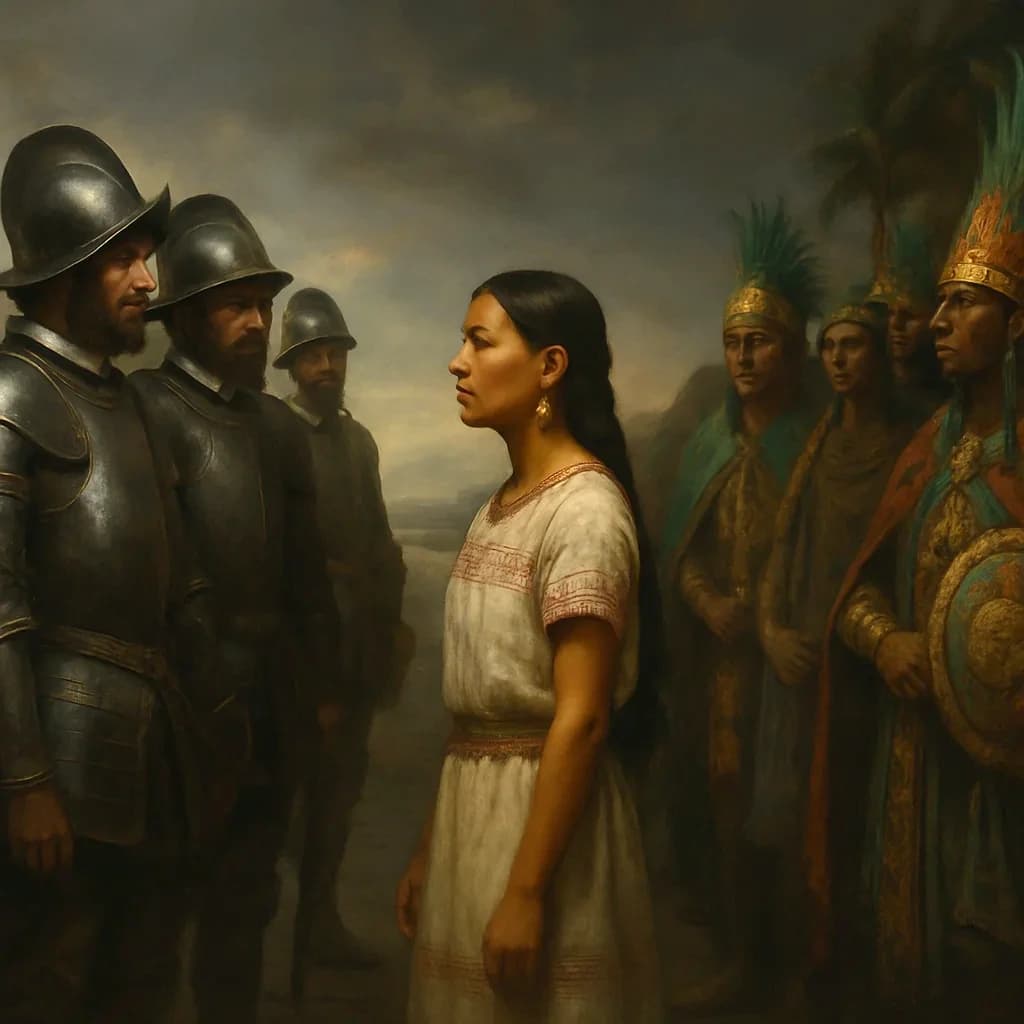
The Voice Behind Cortés's Conquest
Before Hernán Cortés could conquer Mexico, he needed someone who could speak, and that someone was a twenty-year-old enslaved woman named Malintzin, without whom the whole enterprise collapses.
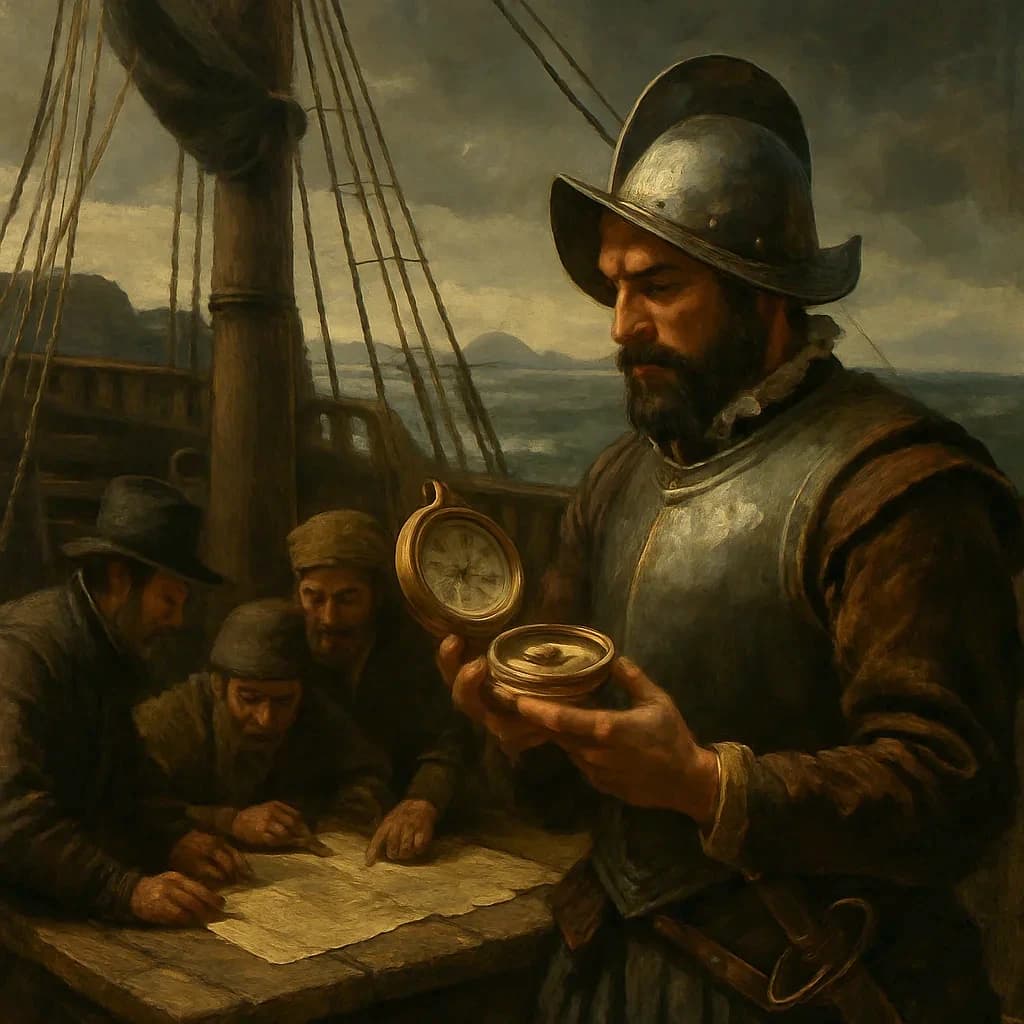
How a Faulty Seville Compass Doomed the Aztecs
A single broken magnetic compass in 1519 steered Spanish explorers away from their intended destination, straight into the heart of the Aztec Empire.
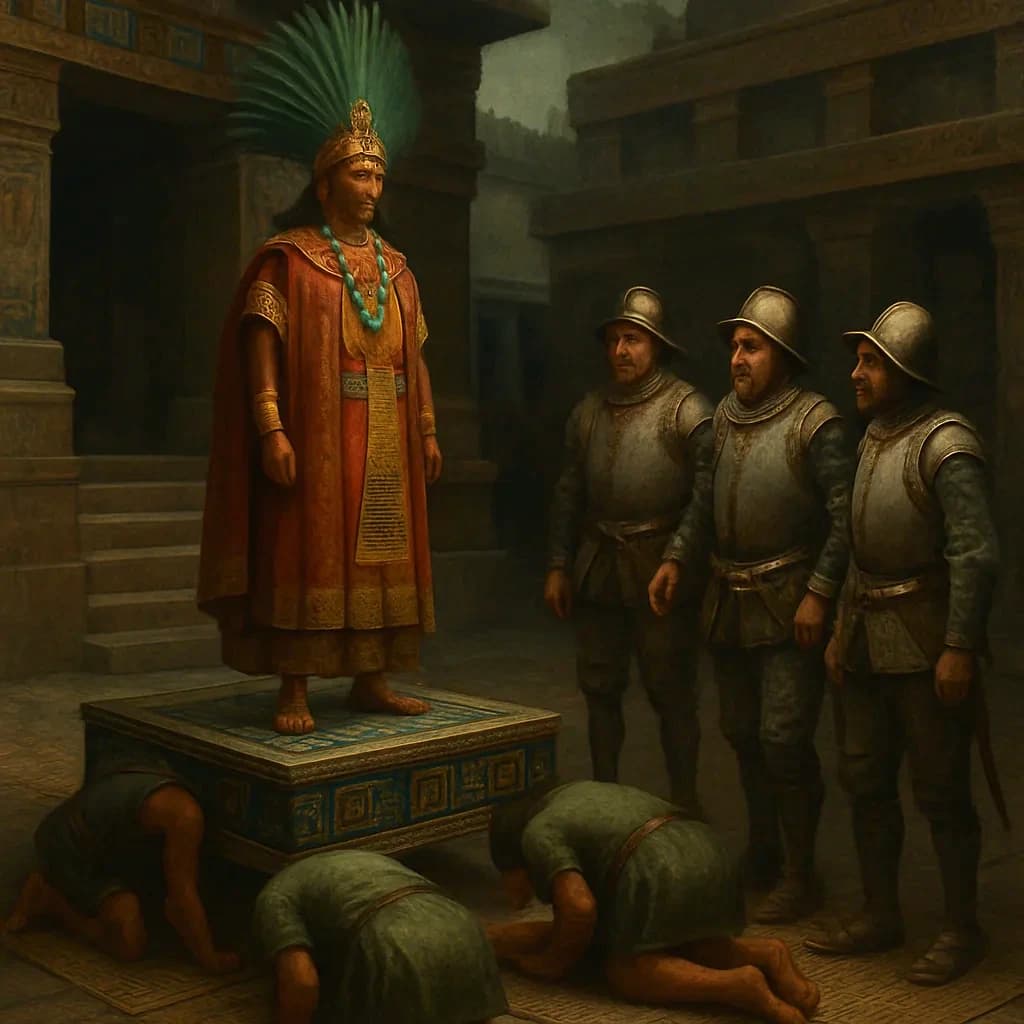
When the Aztec Emperor's Feet Never Touched the Ground
The most powerful ruler in the Americas lived his entire reign without walking on earth, and the Spanish couldn't figure out why.
- Townsend, Richard F. The Aztecs. Thames & Hudson, 2000.
- Restall, Matthew. When Montezuma Met Cortés: The True Story of the Meeting that Changed History. Ecco Press, 2018.
- Díaz del Castillo, Bernal. The True History of the Conquest of New Spain. Trans. Janet Burke and Ted Humphrey. Hackett Publishing, 2012.