
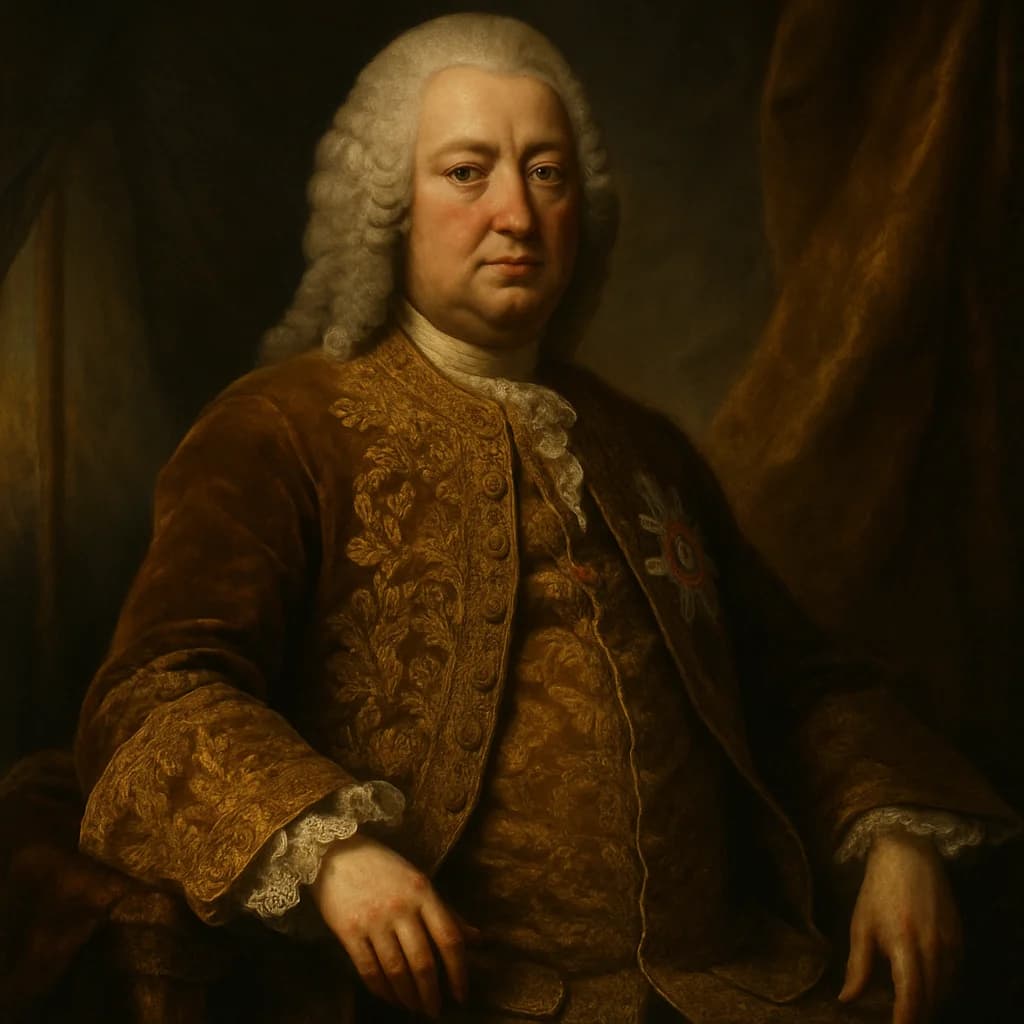
King José I
He ruled Portugal for twenty-seven years and made almost no decisions.
José I became King of Portugal in 1750 and promptly handed the kingdom to someone else. Not through abdication or coup, through preference. He simply did not want the job. What he wanted was opera. He built a private opera house inside the royal palace at Ajuda, imported Italian composers, and attended performances with the fervor other monarchs reserved for war councils. While his ministers argued over trade routes and colonial policy, José was reviewing librettos.
The man who stepped into that vacuum was Sebastião José de Carvalho e Melo, later the Marquis of Pombal, arguably the most consequential political figure in eighteenth-century Europe. Pombal didn't seize power so much as collect it from a king who kept leaving it on the table. By 1755, when the great earthquake leveled Lisbon on the morning of November 1st, killing somewhere between ten and a hundred thousand people, Pombal had already become the functional government of Portugal. The disaster didn't create his dominance. It simply made it undeniable.
What almost no one remembers is that José I developed a pathological fear of enclosed spaces after the earthquake, specifically buildings. He moved the royal court into an elaborate tent city on the hills above Lisbon and refused to sleep indoors for the rest of his life. For nearly two decades, the King of Portugal ruled from a canvas palace. He conducted audiences in tents, slept under canvas, and watched Pombal rebuild the city's stone streets from a distance he was never willing to close. The grandeur of Pombal's rebuilt Baixa district (the rationalist grid still visible in Lisbon today) was commissioned by a king who couldn't bring himself to enter it.
The assassination attempt of 1758 briefly made José relevant to his own reign. Gunmen attacked his carriage returning from a rendezvous; he survived, wounded. Pombal used the attack to destroy the Távora family and break the Jesuit order in Portugal entirely. Whether José sanctioned the severity of what followed remains genuinely unclear. He signed the warrants. He also, by most accounts, signed whatever Pombal set in front of him.
José I slept in a tent complex outside the royal palace for the last eighteen years of his reign, having never recovered psychologically from the 1755 earthquake, making him likely the only European monarch of the era to govern an empire while clinically refusing to sleep indoors.
Why untold: Because Pombal's story is so operatically dominant that historians have treated José I as a prop in it rather than as a psychologically distinct figure whose passivity was itself a consequential political act.

Lisbon Rebuilt the City but Never the Records
An earthquake destroyed Portugal's capital in six minutes, and the more interesting disaster took another century.

Lisbon's Earthquake and the Slow Loss of Brazil
The earthquake that leveled Lisbon also quietly ended Portugal's golden age, but not in the way anyone expected.

The Earthquake That Chose a King
When Lisbon shook for six minutes in 1755, it didn't just topple buildings. It toppled the most powerful minister in Europe and rewrote the rules of how nations survive catastrophe.
- Kenneth Maxwell, Pombal: Paradox of the Enlightenment (Cambridge University Press, 1995)
- T.D. Kendrick, The Lisbon Earthquake (Methuen, 1956)
- Ana Cristina Araújo, 'The Lisbon Earthquake of 1755: Public Distress and Political Propaganda,' e-Journal of Portuguese History, Vol. 4, No. 1 (2006)