
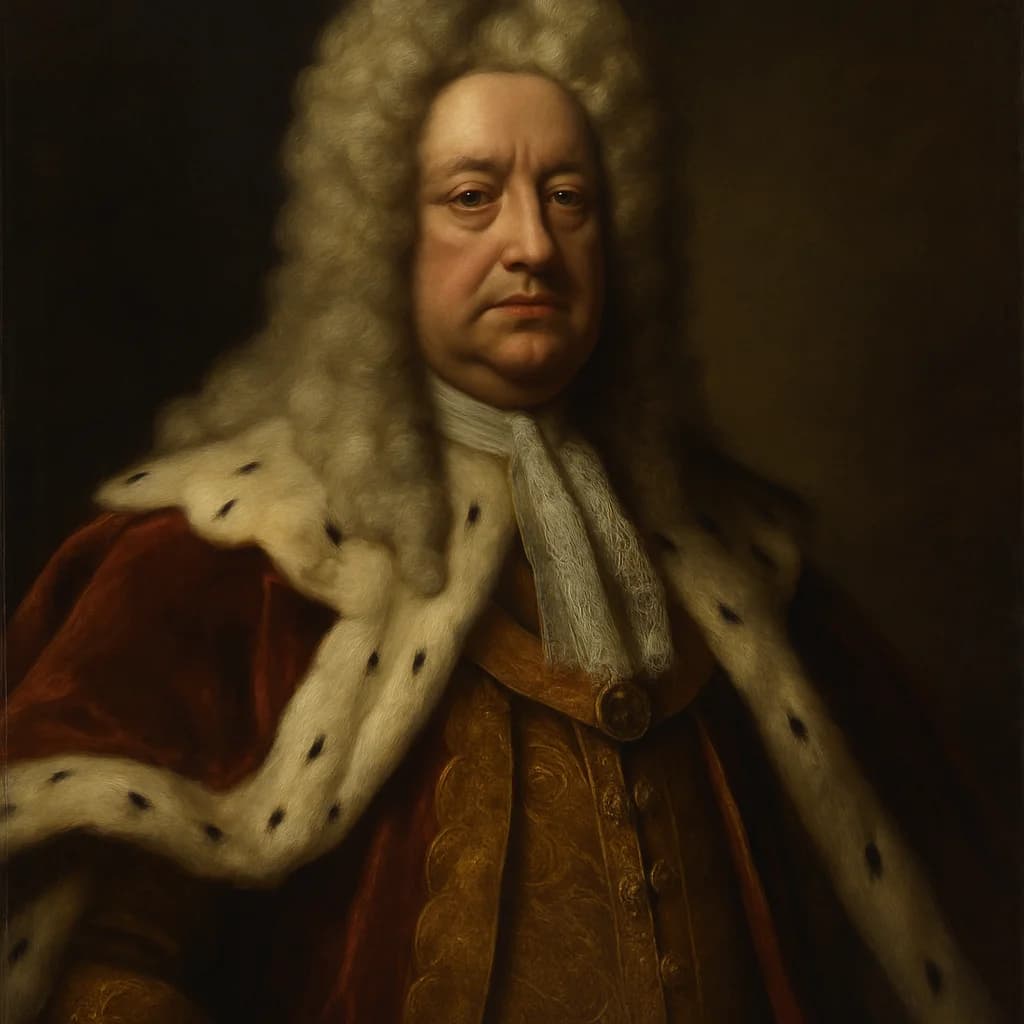
King George I
He ruled Britain for thirteen years without ever learning to speak English.
When George Louis of Hanover was proclaimed King of Great Britain in August 1714, he was fifty-four years old, spoke German and French, read Latin, and had precisely zero interest in learning the language of his new kingdom. He arrived in London that September to inherit a country he had never visited, governing a people whose conversations he could not follow, surrounded by ministers whose arguments he could not understand. He managed this, largely, by not caring. His Cabinet meetings became something genuinely strange: a king who couldn't speak English presiding over ministers who couldn't speak German, everyone muddling through in broken Latin or waiting for a translator who was inevitably wrong about something.
What this accident of language actually produced was the modern office of Prime Minister. Because George couldn't chair his own Cabinet sessions coherently, he stopped attending them. Into that vacuum stepped Robert Walpole, who understood immediately that an absentee king was an opportunity. By 1721, Walpole had consolidated enough authority that historians now call him Britain's first Prime Minister, a title that didn't officially exist, built entirely on the structural gap left by a monarch who found his own government meetings incomprehensible.
There is something almost slapstick about George's role in the South Sea Bubble of 1720, which appears in Untold Archives as a catastrophe that nearly unmade the British Empire. George was not merely a bystander. He was the company's governor, its royal figurehead, the name that made nervous investors feel safe. When the bubble collapsed and roughly £100 million in paper wealth evaporated, Parliament screamed for blood. George survived because he was the king, and because Walpole (brilliant, calculating Walpole) performed a masterclass in selective prosecution that protected the Crown while sacrificing everyone else. The king who couldn't understand the hearings about the crisis that bore his implicit endorsement was saved by a minister who understood English politics better than any king ever had.
He died in 1727 in his carriage, crossing into Hanover on the way to visit the land he had never stopped preferring to Britain. He had made it home once every few years. His son, George II, hated him thoroughly. His grandson would go mad. The dynasty, by any measure, was a disaster. And yet the constitutional machinery George accidentally set in motion (parliamentary sovereignty, cabinet government, Prime Ministerial authority) outlasted every king who came after him.
George I had his own wife, Sophia Dorothea of Celle, imprisoned in a castle for over thirty years after she had an affair. She died there in 1726, the year before he did, having never been freed or divorced.
Why untold: George's incompetence is usually treated as comedy rather than cause, obscuring the fact that his linguistic and political disengagement was the precise structural condition that created the British parliamentary system we recognize today.
When the Royal Baby Died and Democracy Was Born
A single infant's death in 1700 set off a chain reaction that invented the modern British parliamentary system, and nobody saw it coming.
One Bookkeeper's Rumors Erased Half of England's Wealth
A London wine merchant's creative bookkeeping triggered England's most catastrophic financial bubble.
A Coffee Clerk's Typo and Britain's First Crash
A coffee merchant's arithmetic error in London's Lloyd's Coffee House triggered the world's first stock market crash and nearly toppled the British Empire.
- Ragnhild Hatton, George I: Elector and King (Thames and Hudson, 1978)
- John H. Plumb, Sir Robert Walpole: The Making of a Statesman (Cresset Press, 1956)
- John Carswell, The South Sea Bubble (Cresset Press, 1960)