
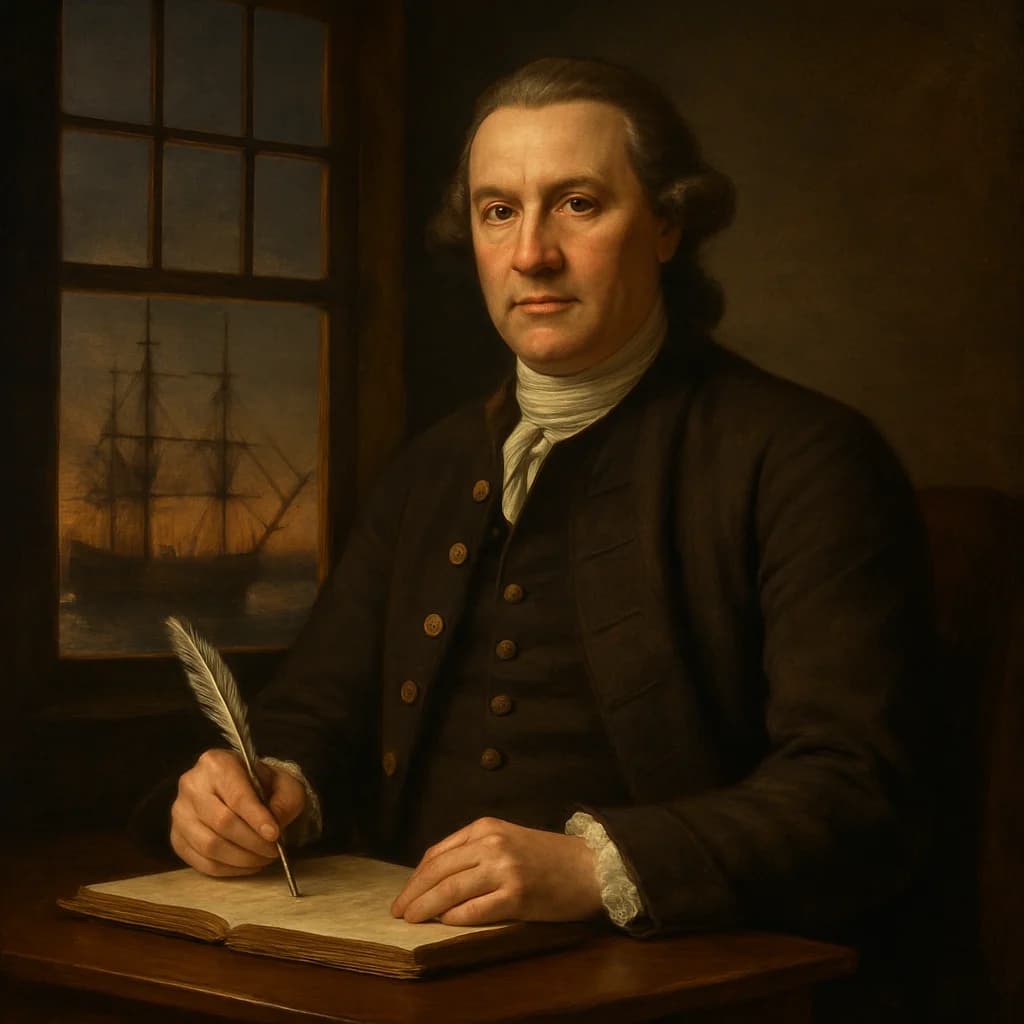
Joshua Winslow
He was supposed to be one of the most powerful men in Massachusetts. Instead, he became the accidental fulcrum of a revolution he desperately wanted to stop.
Joshua Winslow was born in 1727 into Massachusetts royalty. Not the metaphorical kind. His family had governed the Plymouth Colony for generations, his ancestors had broken bread with Pilgrims, and by the time Joshua reached adulthood, the Winslow name opened every door worth opening in colonial New England. He became a prosperous merchant, a justice of the peace, and (the appointment that would ruin him) a consignee for the East India Company's tea shipments arriving in Boston in the autumn of 1773.
That job, on paper, was a windfall. The Tea Act had handed a small circle of loyalist merchants exclusive rights to sell the Company's product at prices that would undercut every smuggler in the harbor. Winslow and his partners stood to make a fortune. What they got instead was a mob outside their doors, their names printed in pamphlets as enemies of liberty, and a very clear message from the Sons of Liberty: resign, or else. Most of the other consignees held firm, sheltering in Castle William under British military protection while waiting for the political weather to change. Winslow read the room differently. He quietly withdrew from the consignment, stepped back, and tried to become invisible.
It didn't work. When the tea ships arrived and the colonial government deadlocked over whether to let them return to England, Winslow's earlier proximity to the whole affair made him a marked man regardless. His attempt to stay neutral satisfied no one. Patriots remembered his original appointment, and loyalists noted his retreat. He was, in the brutal arithmetic of revolution, too compromised for one side and too cautious for the other. When the tea went into the harbor on December 16, 1773, Winslow wasn't there. He was somewhere in Boston, watching an empire crack along a fault line that ran, in some small way, directly through him.
He eventually fled to England during the war, his estates confiscated under Massachusetts's Banishment Act of 1778. He died in 1801, in exile, having outlived the country he was born into by twenty-five years.
Winslow's family name was so deeply woven into New England's founding mythology that even his political enemies initially hesitated to target him directly. It was, according to contemporary correspondence, like attacking Plymouth Rock itself.
Why untold: Winslow's story was absorbed into the larger loyalist exodus narrative, his specific role in the tea crisis flattened by historians who found the consignees who held out (like the Clarke family) more dramatically useful than one who quietly walked away.
When Horses Drank Tea in Boston Harbor
A minor customs dispute over animal feed nearly prevented the American Revolution from happening at all.
The Polite Lunch Before the Boston Tea Party
A simple lunch invitation in 1773 Boston triggered a chain reaction that would split an empire and birth a nation.
- Benjamin Woods Labaree, 'The Boston Tea Party' (Oxford University Press, 1964)
- Sabine, Lorenzo, 'Biographical Sketches of Loyalists of the American Revolution' (Little, Brown and Company, 1864)
- Massachusetts General Court, 'Acts and Resolves of the Province of Massachusetts Bay,' Banishment Act records, 1778