
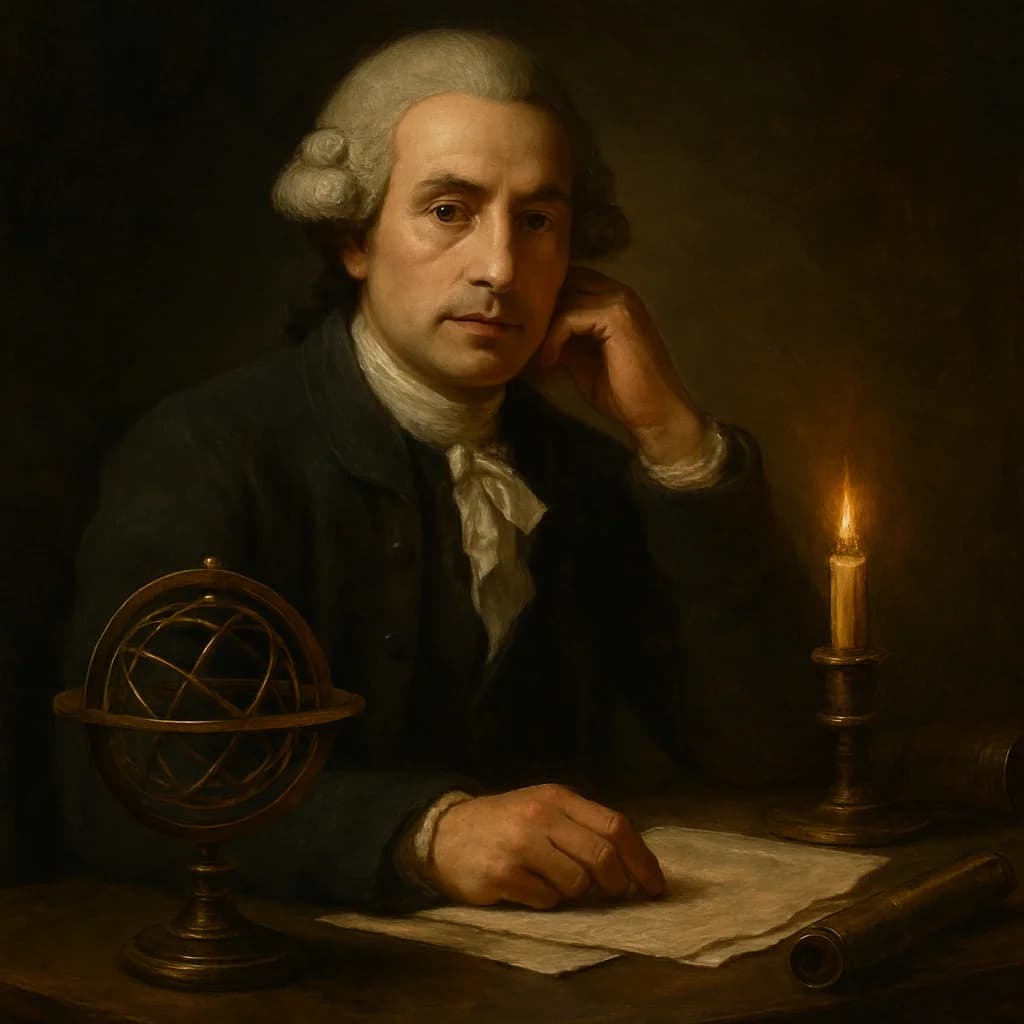
Jean Sylvain Bailly
The astronomer who calculated the orbit of Halley's Comet also calculated the precise moment to execute a king.
Jean Sylvain Bailly spent his early years charting the movements of celestial bodies, never imagining he would soon orchestrate the movements of revolutionary crowds. Born into Parisian intellectual circles in 1736, he made his reputation studying Jupiter's moons and publishing elegant treatises on the history of astronomy. His mathematical precision earned him membership in the Academy of Sciences before he turned thirty.
Then came 1789, and suddenly the same methodical mind that tracked planetary orbits found itself navigating the chaotic gravitational pull of revolution. When the Third Estate broke away to form the National Assembly, they chose Bailly as their president, not for his political experience, which was nonexistent, but for his reputation as an incorruptible man of science. He administered the Tennis Court Oath with the same measured precision he once applied to astronomical observations.
As the first mayor of revolutionary Paris, Bailly tried to apply scientific rationality to mob rule. He established the National Guard, implemented municipal reforms, and attempted to maintain order while revolution swirled around him. But mathematics proved useless against the mathematics of violence. When his guards fired on demonstrators at the Champ de Mars in July 1791, killing dozens, Bailly became the face of moderate betrayal.
The revolution devoured its early heroes with particular appetite. In 1793, the same crowds that once cheered Bailly's astronomical lectures dragged him to the guillotine. His executioners forced him to kneel in mud and freezing rain for an hour before the blade fell, mockingly asking if he was cold. The man who had spent decades studying the precise movements of distant worlds died shivering in the unpredictable chaos of his own.
Bailly wrote a twelve-volume history of astronomy while simultaneously serving as mayor of Paris during the most turbulent years of the French Revolution.
Why untold: His scientific achievements are overshadowed by his brief but dramatic political career, while his political role is reduced to a footnote about moderate failure.

- Simon Schama, Citizens: A Chronicle of the French Revolution
- Charles Coulston Gillispie, The Montgolfier Brothers and the Invention of Aviation
- Steven Shapin, The Scientific Revolution