

James Lind
He proved the cure for scurvy in 1747, and the British Navy ignored him for forty-two years.
James Lind ran the most successful clinical trial in naval history aboard HMS Salisbury in May 1747. Twelve scurvy-ridden sailors, divided into six pairs, each given a different remedy: vinegar, seawater, cider, sulfuric acid diluted in water, a paste of garlic and mustard, or two oranges and a lemon. Within a week, the citrus pair were back on their feet. The others were not. Lind had, by any reasonable measure, cracked it. He was thirty years old and had just saved the British Empire. Nobody cared.
The uncomfortable truth about Lind is that he was a better scientist than he was an advocate. His 1753 Treatise on the Scurvy, which detailed the trial in meticulous and readable prose, buried its own findings in three hundred pages of competing theories, historical digressions, and Lind's persistent, baffling insistence that damp sea air was also somehow to blame. He couldn't fully let go of the old humoral frameworks that scurvy disrupted. The cure was in the book. The book also hedged the cure into near-incoherence. Naval administrators read the hedging and moved on.
What almost no one mentions is what Lind spent the rest of his career on instead. Appointed physician to the Royal Naval Hospital at Haslar in 1758, he ran what was then the largest hospital in the world, up to five thousand patients at a time. His obsessive focus there was not scurvy but typhus and dysentery, the diseases that actually killed the most sailors. He pioneered fumigation procedures, overhauled sanitation protocols, and pushed for fresh clothing for incoming patients, practical public health reforms that saved enormous numbers of lives and earned him almost no historical recognition whatsoever. He died in 1794, the same year the Navy finally mandated lemon juice for all sailors. He was seventy-eight. Whether he knew the policy had passed before he died is not recorded.
The citrus trial made him famous posthumously. The forty-two years of institutional inertia between proof and policy: that part gets quietly skipped.
During Lind's tenure at Haslar Hospital, he admitted over 110,000 patients in a single decade, making his administrative and sanitation work arguably responsible for more lives saved than the scurvy trial itself.
Why untold: The scurvy experiment is a tidy origin story, so the half-century of bureaucratic delay and Lind's far larger career in hospital sanitation reform get collapsed into a footnote.

Forty-Seven Years to Believe a Cure for Scurvy
A Scottish surgeon's 1747 lime juice experiment saved millions of sailors, and the Royal Navy's refusal to use it for decades handed rivals a head start at sea.
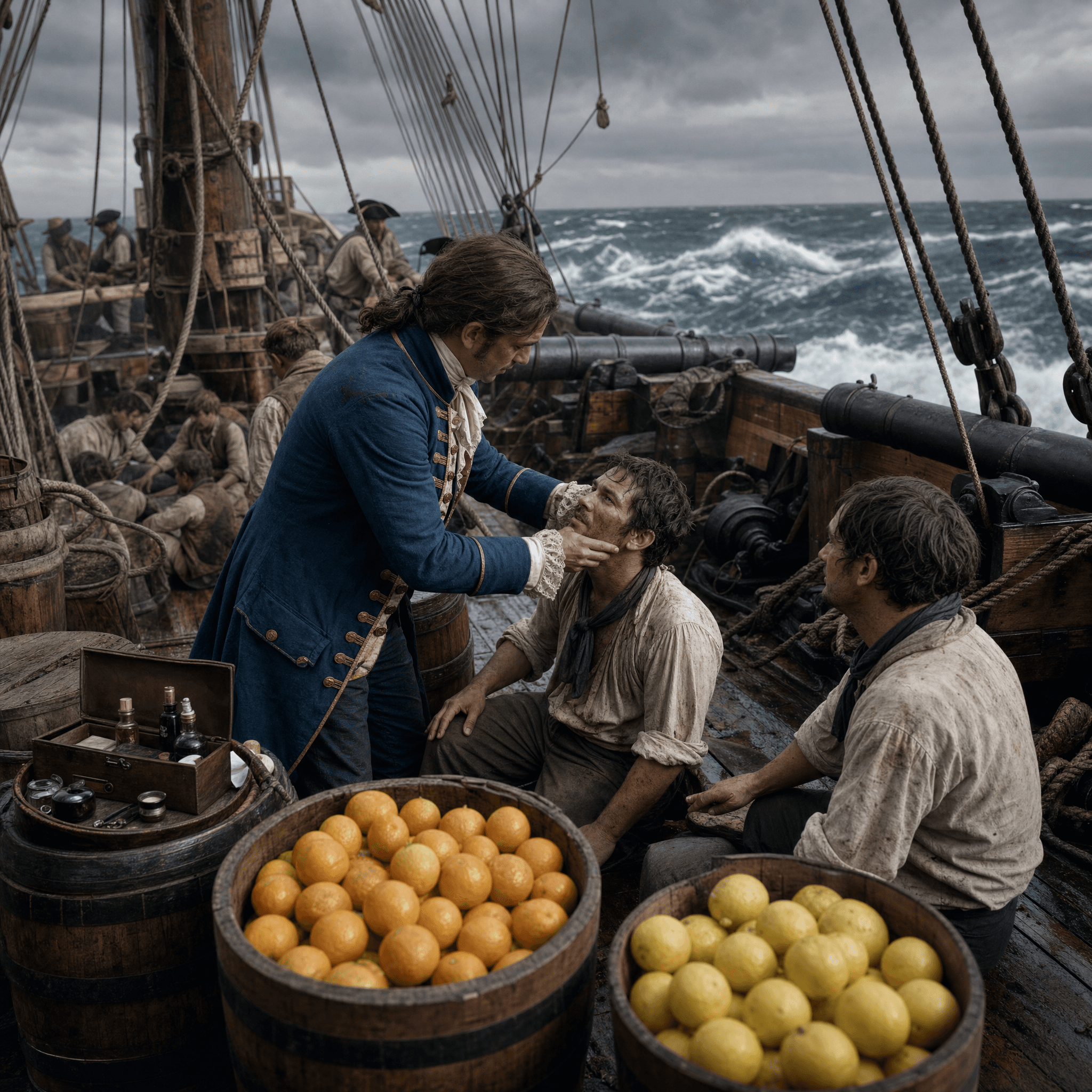
A Surgeon's Fruit Obsession Built History's Most Feared Navy
A ship's surgeon's fruit obsession accidentally created the most feared navy in history.

How Citrus Built the British Navy
A British naval surgeon's simple experiment with citrus fruits accidentally created the most feared navy in history.
- Lind, James. A Treatise of the Scurvy. Edinburgh: Sands, Murray and Cochran, 1753.
- Harvie, David I. Limeys: The True Story of One Man's War Against Ignorance, the Establishment and the Deadly Scurvy. Stroud: Sutton Publishing, 2002.
- Bartholomew, Michael. 'James Lind's Treatise of the Scurvy (1753).' Postgraduate Medical Journal 78, no. 925 (2002): 695-696.