
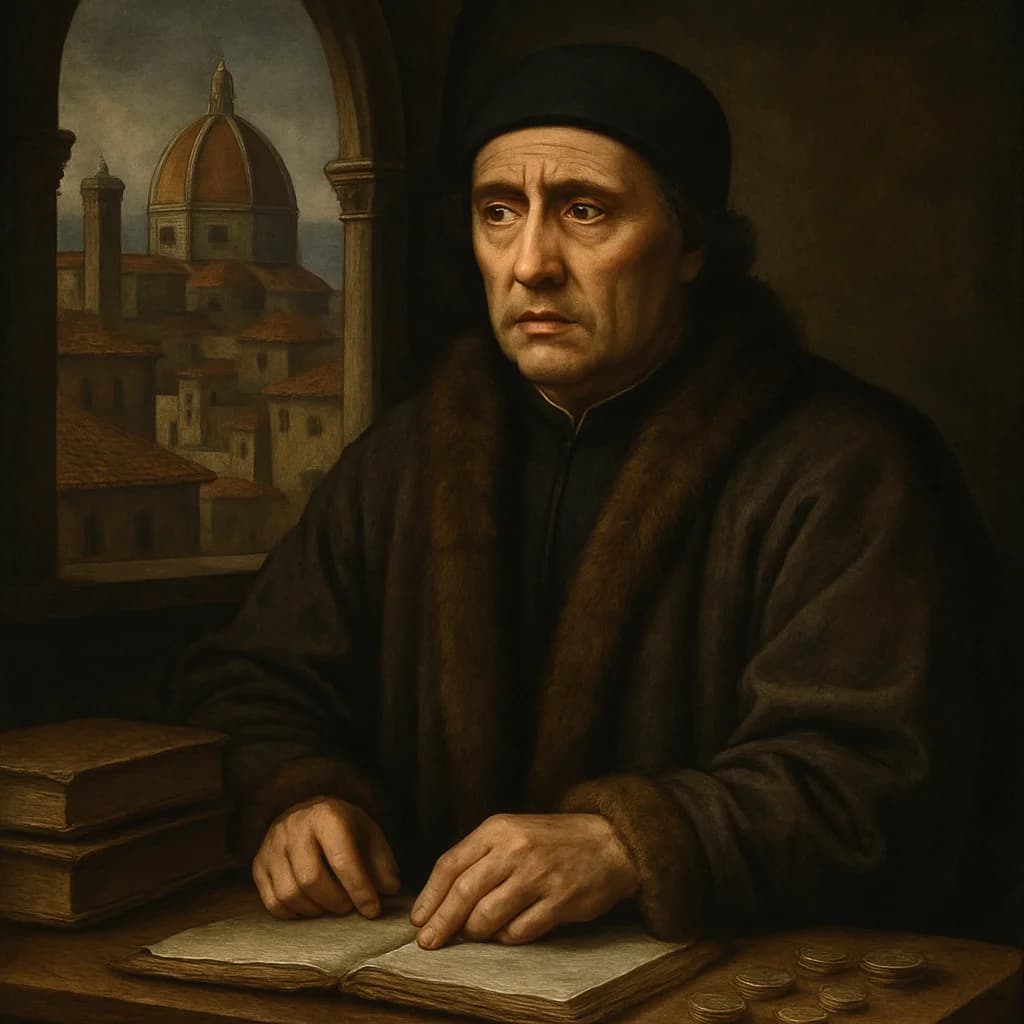
Giovanni de' Medici
The man who invented modern banking died convinced he was going to hell for it.
Giovanni de' Medici spent his final years obsessing over a single theological question: could a banker's soul be saved? The irony was exquisite. This son of a money-changer had just revolutionized European finance, creating the double-entry bookkeeping system that would power capitalism for centuries. Yet he lay awake nights wondering if his innovations were an elaborate path to damnation.
The Church's position on usury was clear: lending money at interest was a mortal sin. Giovanni found a loophole that would make a modern tax attorney weep with joy. Instead of charging interest, he offered "exchange services," converting currencies at rates that just happened to include a healthy profit margin. When English wool merchants needed florins, Giovanni's banks provided them. When Flemish textile producers required sterling, the Medici network delivered. The margins looked like fees, not interest. God, presumably, was fooled.
But Giovanni's real genius lay in his response to near-bankruptcy in 1402. When a cascade of bad debts from English clients threatened to destroy the family fortune, he didn't retreat into conservative lending. Instead, he doubled down on the very relationships that had nearly ruined him, extending credit to artists, scholars, and the politically ambitious. These weren't safe bets. They were desperate gambles that happened to fund the Renaissance.
By 1429, Giovanni had built the largest banking network in Europe, with branches from London to Constantinople. Yet he died that same year convinced his wealth was spiritually poisonous, leaving detailed instructions for masses to be said for his soul. His son Cosimo inherited both the fortune and the guilt, eventually commissioning Donatello and Brunelleschi to build his father's way into heaven. The churches they created became monuments to a very modern anxiety: what happens when your business model might damn you?
Giovanni de' Medici's bank invented the concept of the "letter of credit" to avoid usury laws, a financial instrument so useful that it's still used in international trade today, virtually unchanged from his 15th-century design.
Why untold: His moral anguish over banking practices is overshadowed by his family's later political prominence and artistic patronage.

A Merchant Skipped Town and Left Behind Lost Plato
A silk merchant's ledger nearly bankrupted the most powerful banking family in Europe, and their desperate gamble ended up funding the rebirth of human knowledge.

Giovanni de' Medici Bet on Borrowers Who Couldn't Pay
A Florentine banker's desperate gamble with English wool turned into the financial foundation of the Renaissance.
- Padgett, John F. and Paul D. McLean. 'Organizational Invention and Elite Transformation: The Birth of Partnership Systems in Renaissance Florence.' American Journal of Sociology, 2006.
- De Roover, Raymond. 'The Rise and Decline of the Medici Bank, 1397-1494.' Harvard University Press, 1963.
- Goldthwaite, Richard A. 'The Economy of Renaissance Florence.' Johns Hopkins University Press, 2009.