

Peter Minuit
The man who accidentally created capitalism's greatest mathematical embarrassment spent his final years as a Swedish spy plotting against his former Dutch employers.
Peter Minuit's arithmetic was catastrophically bad. In 1626, as director-general of New Netherland, he purchased Manhattan Island from the Lenape for goods worth 60 guilders, roughly $24 in 19th-century calculations. What seemed like shrewd colonial bargaining was actually a bookkeeping disaster of epic proportions. Minuit had fundamentally misunderstood both the transaction and basic compound interest.
The Lenape weren't selling Manhattan in any European sense. They were granting seasonal hunting and fishing rights, a concept that didn't translate into Dutch property law. Meanwhile, Minuit's 60 guilders, if invested at a modest 5% annual return, would be worth over $2.5 trillion today. He had accidentally executed history's worst real estate deal, creating a mathematical cautionary tale that wouldn't be fully understood until the 20th century.
But Minuit's miscalculations extended beyond Manhattan. Fired by the Dutch West India Company in 1631 for unauthorized trading, he immediately defected to Sweden, becoming director of the New Sweden Company. His mission: establish Swedish colonies in the Delaware Valley, directly competing with his former employers. This wasn't simple career advancement. It was calculated revenge.
Minuit's Swedish venture succeeded brilliantly until 1638, when his ship Kalmar Nyckel was lost in a Caribbean hurricane during a trading expedition. He died having founded two colonial settlements, betrayed one European power, and created a mathematical problem that would perplex economists for centuries. His legacy wasn't conquest or exploration. It was proof that colonial ambition combined with poor arithmetic could reshape continents.
Minuit's purchase of Manhattan wasn't recorded in any official Dutch document. The famous $24 figure comes from a 19th-century historian's guess about the value of trade goods mentioned in a single letter.
Why untold: His mathematical incompetence was overshadowed by the romantic mythology of Manhattan's "purchase," while his Swedish espionage career was buried in Scandinavian archives.
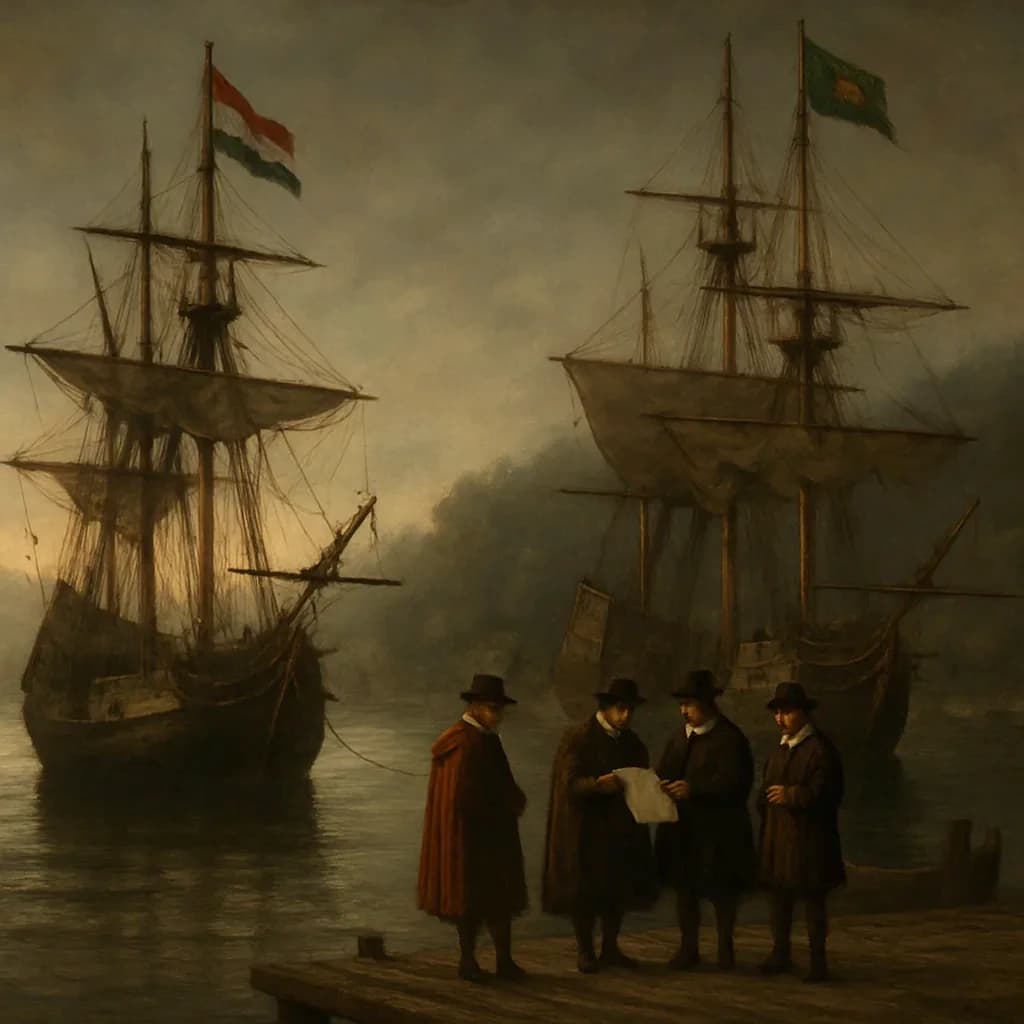
How a Spilled Inkwell Almost Gave Portugal Manhattan
A minor clerical error in a Dutch trading post almost handed New York to the Portuguese Empire.

A Bookkeeper's Math Error Created History's Priciest Real Estate Deal
A Dutch bookkeeper's miscalculation in 1626 accidentally created the world's most expensive real estate purchase.

The $24 Manhattan Deal Was a Bookkeeping Error
A single arithmetic slip in 1626 produced what's called the most expensive real estate transaction in history, and nobody caught it for 300 years.
- Russell Shorto, The Island at the Center of the World: The Epic Story of Dutch Manhattan and the Forgotten Colony That Shaped America
- Jaap Jacobs, The Colony of New Netherland: A Dutch Settlement in Seventeenth-Century America
- Stellan Dahlgren and Hans Norman, The Rise and Fall of New Sweden: Governor Johan Risingh's Journal 1654-1655