
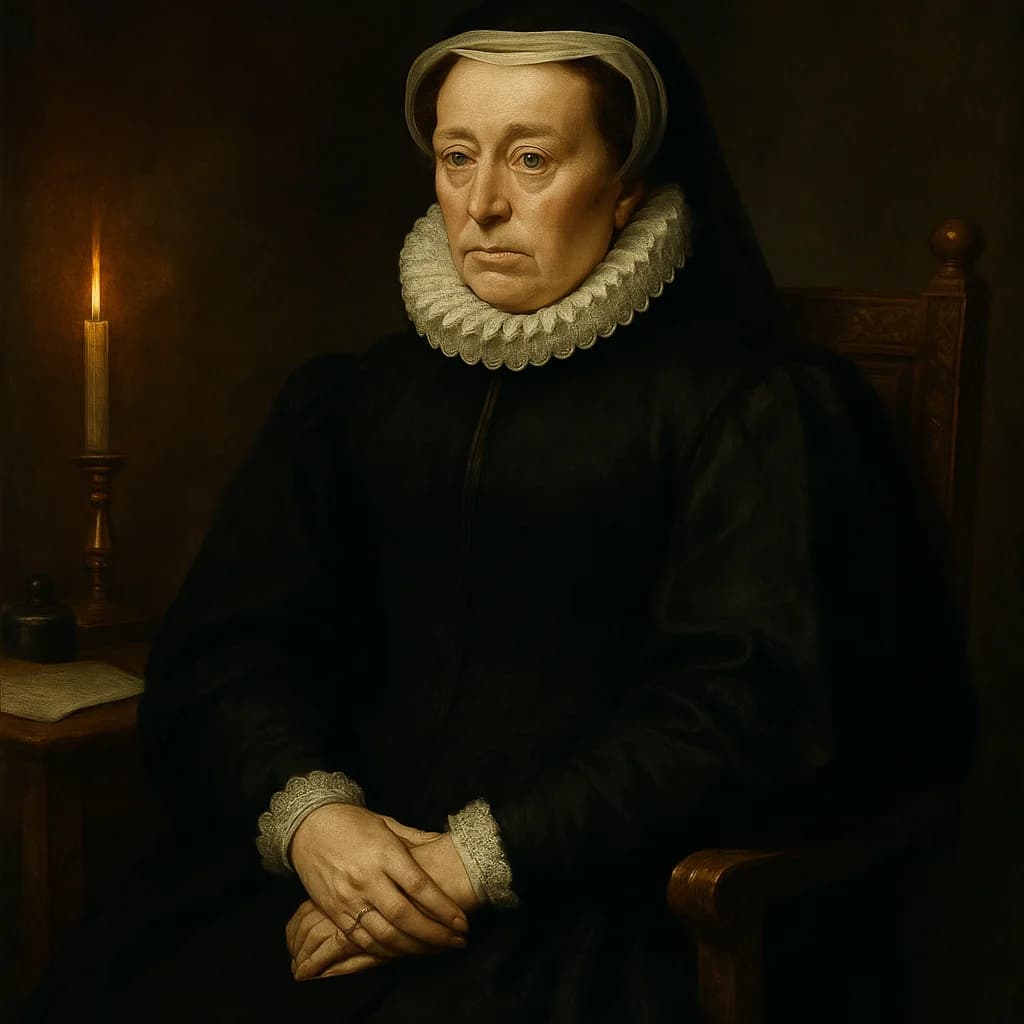
Catherine de Medici
She was mocked as a merchant's daughter her entire life, so she spent forty years proving that merchants know better than anyone how to collect debts.
The insult followed Catherine de Medici from Florence to Paris and never quite left. 'The Italian woman.' 'The merchant queen.' When she arrived in France in 1533 as a fourteen-year-old bride for the future Henri II, the court received her with the particular cruelty that aristocracies reserve for people who have money but not blood. Her Medici fortune had bought the marriage. Everyone made sure she remembered it.
What they missed (what almost everyone still misses) is that Catherine spent the next two decades in a masterclass of enforced patience. Henri ignored her in favor of his mistress, Diane de Poitiers, a woman twenty years his senior who openly wore his colors at tournaments while Catherine watched from the stands. For twenty-five years Catherine held no real power. She read. She corresponded. She learned the architecture of French noble families the way a general studies terrain before a battle. When Henri died in a jousting accident in 1559 (a lance splintered through his visor, killing him slowly over ten agonizing days), Catherine was forty years old and had been waiting for two decades. She put on the black she would wear for the rest of her life and went to work.
What followed is where the popular history both gets it right and catastrophically wrong. Yes, the St. Bartholomew's Day Massacre of August 1572 happened under her watch, almost certainly with her approval, killing somewhere between five and thirty thousand Huguenots in Paris and the provinces. That part is remembered. What isn't is the decade before it: Catherine's sustained, exhausting effort to prevent exactly that outcome. She negotiated the Edict of January 1562, extending limited legal protections to French Protestants. She organized the Colloquy of Poissy in 1561, an actual theological debate between Catholic and Protestant scholars she personally convened, trying to find doctrinal ground that might hold France together. It failed. Every attempt failed. The nobility on both sides wanted war more than they wanted peace, because war was profitable and peace required compromise.
She didn't create France's religious wars. She inherited them, managed them, occasionally made them worse, and ultimately couldn't stop them. That's a more honest and more troubling story than the poisoner queen: a pragmatist who ran out of room.
Catherine introduced the side-saddle riding position to the French court as a young woman, having grown up riding that way in Italy, a style that then spread across European aristocracy and became the standard for women's equestrian fashion for the next three centuries.
Why untold: The 'Black Queen' poisoner legend, enthusiastically promoted by Protestant propagandists during her lifetime and never fully corrected, has functioned as a narrative shortcut that replaced the more complicated and less satisfying story of a woman who spent thirty years attempting diplomacy that her era was constitutionally incapable of accepting.

Secret Clauses: How Scotland Nearly Became French
Mary of Guise buried hidden clauses in a marriage treaty to protect her daughter, and helped hand Scotland's crown to England.
How a Royal Wedding Masked 23,000 Murders
A banquet hall full of plates sat empty in 1572 while an empire fell.
- Leonie Frieda, Catherine de Medici: Renaissance Queen of France (HarperCollins, 2003)
- R.J. Knecht, Catherine de' Medici (Longman, 1998)
- Mark Greengrass, France in the Age of Henri IV: The Struggle for Stability (Longman, 1984)